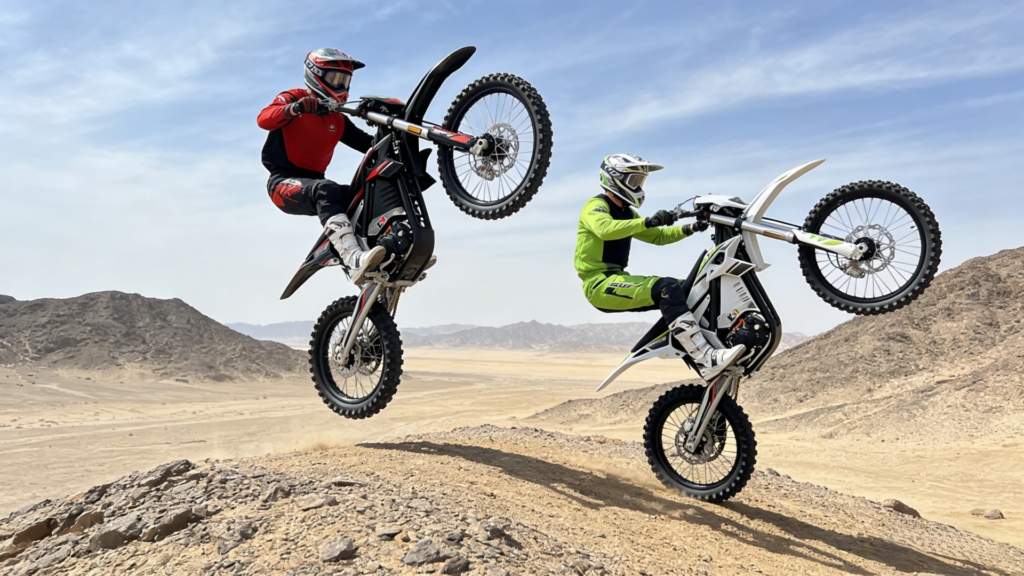

How silent power and sustainable exploration are revolutionising the great outdoors
There’s a peculiar sensation that comes with cresting a ridge at dawn, the first golden rays of sunlight spilling across an untouched valley, and realising that the only sounds accompanying your arrival are the whisper of tyres on loose scree and the distant call of a curlew. No throaty exhaust note. No plume of blue smoke hanging in the morning air. Just you, the machine beneath you, and the wilderness stretching out in every direction.
This is the new face of adventure motorcycling. Welcome to 2026, where the electric dirt bike has matured from curious novelty to genuine outdoor companion, and where the camping trip has been reimagined for a generation that refuses to choose between thrills and responsibility.
The Silent Revolution
Cast your mind back merely half a decade, and the notion of an electric dirt bike capable of genuine off-road exploration seemed fanciful at best. Range anxiety, charging limitations, and the scepticism of traditional riders created formidable barriers. Yet here we stand in 2026, witnessing what can only be described as a paradigm shift in how we access the wild places.
The modern electric dirt bike bears little resemblance to its early predecessors. Battery technology has advanced at a staggering pace, with energy densities now allowing for 150-mile mixed-terrain ranges becoming standard across premium models. Regenerative braking systems, refined through years of road-going electric vehicle development, now recover meaningful energy during technical descents. Most crucially, the charging infrastructure has proliferated through rural Britain and beyond, with rapid chargers appearing at country pubs, farm shops, and dedicated adventure hubs.
But it isn’t merely the technology that has evolved—it’s the philosophy. The electric dirt bike represents something profound: a reconciliation between our desire for mechanised adventure and our growing environmental consciousness. For the camping enthusiast, this synthesis opens possibilities that were previously inconceivable.
Why Electric Changes Everything
Traditional dirt bike camping has always carried an inherent tension. The very machines that grant us access to remote beauty spots also announce our presence with considerable fanfare. Two-stroke engines, in particular, create acoustic footprints that can be detected miles away, whilst their emissions leave tangible traces in sensitive environments.
The electric alternative obliterates these compromises. At walking pace through woodland tracks, an electric dirt bike produces scarcely more noise than a mountain bicycle. This acoustic stealth transforms the experience fundamentally. Wildlife encounters become more frequent and intimate. Fellow campers aren’t disturbed by late-evening arrivals. The sense of intrusion upon nature diminishes dramatically.
Consider the practical implications for the wild camper. In Britain, where access rights and land sensitivities create complex navigation, the ability to traverse terrain without drawing attention becomes genuinely valuable. Electric dirt bikes can utilise green lanes and byways with minimal impact, their low ground pressure and instant torque often proving superior to conventional machines in technical sections.
The absence of emissions also means you can camp in your chosen spot without the guilt—or the reality—of contributing to local air degradation. In enclosed valleys or dense woodland, where petrol engines produce concentrated pollution, the electric alternative leaves the atmosphere as pristine as you found it.
Planning Your 2026 Electric Adventure
Embarking upon an electric dirt bike camping trip requires a subtly different mindset from traditional motorcycle touring. The fundamentals remain familiar: route planning, equipment selection, and contingency preparation. Yet the electrical dimension introduces new considerations that, once mastered, become second nature.
Route Architecture
The contemporary electric adventurer thinks in terms of charging nodes rather than fuel stations. Fortunately, the mapping has become sophisticated. Dedicated applications now overlay charging infrastructure with rights of way, elevation profiles, and terrain difficulty. The art lies in constructing routes that naturally incorporate charging opportunities without compromising the spirit of exploration.
A typical British weekend might unfold thus: departure from a home base with full charge, morning traverse of green lanes and byways, arrival at a rural pub offering rapid charging and a substantial lunch, afternoon exploration of more technical terrain, and evening arrival at a wild camping spot within comfortable range of the following morning’s first charging point.
The charging itself has become remarkably efficient. Modern rapid chargers can restore 80% capacity in forty minutes—sufficient time for a proper meal and route review. Many adventure-oriented establishments now offer secure bike parking with integrated charging, recognising the growing market of electric explorers.
Equipment Evolution
Camping gear for electric dirt bike touring has undergone its own quiet revolution. The absence of vibration and heat from a traditional engine allows for more delicate equipment choices. Lightweight tents and sleeping systems, previously the preserve of bicycle tourists, now become viable for motorised adventurers.
Load distribution requires particular attention. Battery weight is concentrated low in modern electric bikes, creating favourable centre-of-gravity characteristics, but total payload remains a consideration. The contemporary electric dirt bike camper typically carries 15-20 kilograms of equipment, distributed across robust panniers and a compact tail pack.
Power management extends beyond the bike’s propulsion. Many riders now utilise their machine’s substantial battery capacity to charge camping electronics—phones, GPS units, cameras, even compact cooking equipment—through integrated accessory ports. This integration eliminates the need for separate power banks and solar charging systems, simplifying the kit considerably.
The British Landscape: A Perfect Proving Ground
Britain’s diverse terrain and compact geography make it an exceptional laboratory for electric dirt bike camping. From the granite tors of Dartmoor to the peat hags of the Pennines, from the forest tracks of the Scottish Highlands to the coastal paths of Wales, the opportunities for multi-day exploration are extraordinary.
The South West presents perhaps the most developed infrastructure for electric adventure. Devon and Cornwall’s network of farm diversification projects—many now incorporating charging facilities alongside camping and glamping offerings—creates natural corridors for exploration. A three-day circuit might incorporate the granite tracks of Dartmoor, the wooded valleys of the Tamar, and the coastal cliffs of north Cornwall, with charging opportunities at each evening’s destination.
Wales offers more challenging terrain and sparser infrastructure, demanding more careful planning but rewarding with profound solitude. The Cambrian Mountains and surrounding areas contain some of Britain’s most extensive wild camping opportunities, accessed via ancient drovers’ roads and forestry tracks perfectly suited to electric machines.
Scotland presents the ultimate test. The Highland bothies, maintained by the Mountain Bothies Association, provide shelter in some of the most remote landscapes in Britain. Reaching these stone refuges via electric dirt bike requires meticulous range calculation, but the experience—arriving in perfect silence to a bothy as evening falls—justifies the preparation.
A Weekend in the Border Country: A Case Study
To illustrate the practical reality of electric dirt bike camping in 2026, consider a representative weekend in the Anglo-Scottish border region, an area of outstanding natural beauty and complex access rights.
Friday evening departure from Newcastle sees the rider heading northwest on mixed tarmac and gravel, utilising the bike’s dual-sport capabilities. The first night is spent at a certified camping barn near Kielder Forest, where a 7kW charger restores full capacity overnight. Saturday’s route penetrates the forest’s remote northern reaches, following forestry roads and permitted tracks to a bothy in the Cheviot foothills. The 45-mile morning route consumes 35% charge, leaving substantial reserve for afternoon exploration and the return to charging infrastructure.
Sunday’s return incorporates the Pennine Bridleway and several classified green lanes, arriving at a rural café with rapid charging facilities in time for lunch. The final leg home is accomplished with charge to spare, the weekend having covered 180 miles of varied terrain with zero emissions and minimal acoustic impact.
This pattern—overnight slow charging, opportunistic rapid charging, and careful consumption monitoring—has become standard practice. The anxiety that characterised early electric adventure has dissipated with experience and infrastructure development.
The Community Dimension
Perhaps the most unexpected development in electric dirt bike culture has been the emergence of distinct community characteristics. Without the traditional gathering points of petrol stations and bike meets defined by mechanical camaraderie, electric riders have developed alternative social structures.
Online forums and route-sharing platforms have flourished, with riders exchanging detailed charging location reviews, range experiences on specific terrain types, and wild camping recommendations. The emphasis has shifted from mechanical modification to route optimisation and environmental integration.
Group rides have evolved accordingly. The absence of engine noise allows for conversation during transit, fundamentally changing the social dynamic. Riders can discuss navigation, point out wildlife, and maintain awareness of each other’s condition without the traditional stop-and-shout routine. The experience becomes more collaborative, less competitive.
This community extends to land managers and access authorities. The low-impact characteristics of electric machines have facilitated dialogue with organisations traditionally hostile to motorised access. The National Trust, Forestry England, and various national park authorities have begun pilot schemes for permitted electric vehicle access to sensitive areas, recognising the potential for sustainable exploration.
Technical Considerations for the Serious Adventurer
For those contemplating serious electric dirt bike camping, several technical matters warrant attention beyond the obvious charging logistics.
Thermal Management
Battery performance remains temperature-sensitive. Winter camping demands particular attention to battery conditioning, with many riders utilising insulated battery covers and planning routes that maintain sufficient load to generate internal warming. Conversely, summer heat requires awareness of rapid charging limitations—many systems throttle charge rates above 35°C ambient temperature.
Tyre Selection
The instant torque characteristics of electric motors demand particular tyre consideration. Aggressive tread patterns that might suit traditional bikes can prove excessive, promoting unwanted wheelspin and accelerated wear. Many experienced electric riders favour intermediate patterns that balance traction with rolling efficiency, extending range and reducing environmental impact.
Suspension Tuning
The substantial mass of battery systems—typically 40-60kg concentrated low in the chassis—creates unique suspension demands. Modern electric dirt bikes address this through sophisticated damping, but the camping load introduces additional variables. Riders carrying substantial camping equipment often increase compression damping slightly and reduce preload to maintain compliance over rough terrain.
Water Crossing Protocols
Electrical systems demand respect for water ingress, though modern bikes are far more capable than early generations. Established protocols include avoiding submersion beyond wheel height, allowing standing water to drain from connectors before charging, and carrying dielectric grease for emergency sealing. The fundamental rule remains: if you wouldn’t cross it on a conventional bike with exposed air intake, approach with caution on electric.
The Broader Implications
The rise of electric dirt bike camping represents more than a technological transition—it signals a philosophical evolution in our relationship with adventure and environment. The ability to access remote beauty without the traditional accompaniments of noise and pollution challenges us to reconsider what we value in outdoor experience.
For the camping purist, electric motorised access might seem an unacceptable compromise. Yet the reality proves more nuanced. The electric dirt bike camper typically covers distances that would require multiple days of walking, accessing areas that would be impractical with conventional bicycles, whilst maintaining a lighter environmental footprint than any petrol-powered alternative.
The experience itself is transformed. The silence allows for deeper connection with surroundings. The absence of vibration and exhaust reduces fatigue, extending effective riding days. The simplicity of electric powertrains—no oil changes, no filter maintenance, no fuel contamination concerns—reduces the mechanical burden that can dominate traditional adventure motorcycling.
Looking Forward
As we progress through 2026, several developments promise to further enhance electric dirt bike camping. Solid-state battery technology, approaching commercial viability, offers the prospect of 50% range increases without weight penalty. Wireless charging systems, currently in trial deployment at several adventure hubs, may eventually allow charging without the physical connection currently required.
Perhaps more significantly, the cultural normalisation continues apace. What seemed radical three years ago now attracts barely a raised eyebrow at rural pubs and camping spots. The electric dirt bike camper is no longer a curiosity but a recognised participant in the landscape of British outdoor adventure.
Conclusion
The electric dirt bike camping trip of 2026 represents something genuinely new: a form of mechanised adventure that reconciles the desire for exploration with environmental responsibility. It offers access to the wild places of Britain—and beyond—without the traditional costs of acoustic and atmospheric intrusion.
For those who have made the transition, the experience proves difficult to relinquish. The silence becomes addictive, the simplicity liberating, the environmental alignment satisfying. The camping trip, that most venerable of British outdoor traditions, finds in the electric dirt bike a companion worthy of its heritage and its future.
The ridge at dawn awaits. And now, finally, we can approach it without announcing our arrival to the entire valley.
Ready to plan your own electric dirt bike camping adventure? The charging infrastructure awaits, the green lanes are calling, and the bothies stand ready. The future of adventure is silent, sustainable, and spectacularly accessible.


