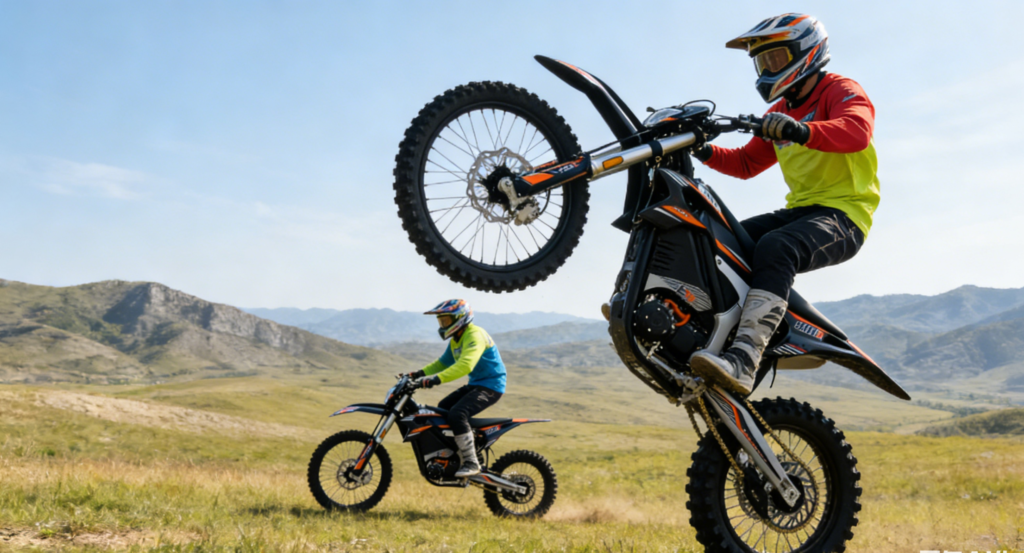

The Quiet Revolution Reshaping Off-Road Motorcycling
The roar of two-stroke engines has long been the soundtrack of enduro and motocross circuits worldwide. Yet beneath this familiar cacophony, a profound transformation is underway. Electric dirt bikes are not merely offering an alternative powertrain—they are fundamentally democratising access to off-road motorcycling, attracting demographics previously alienated by the sport’s traditional barriers. From urban professionals seeking weekend adventure to environmentally conscious millennials and families hoping to share experiences without the intimidation factor of petrol-powered machinery, the electric revolution is expanding the enduro and motocross community in ways that would have seemed improbable merely a decade ago.
Breaking Down the Barriers to Entry
Traditional petrol-powered dirt bikes have historically presented formidable obstacles to newcomers. The maintenance demands alone—mixing fuel, adjusting carburettors, managing oil changes, and troubleshooting mechanical failures—have deterred countless potential enthusiasts. Electric dirt bikes eliminate these complications entirely. With no internal combustion engine, there are no oil changes, no spark plugs to replace, no air filters to clean, and no fuel to mix . This simplicity transforms the ownership experience from a mechanical burden into a pure riding pleasure.
The financial calculus has shifted dramatically as well. Whilst the initial purchase price of quality electric dirt bikes such as the KTM Freeride E-XC at approximately $8,300 or the Cake Kalk& at $14,000 may appear substantial , the total cost of ownership tells a rather different story. Electric powertrains boast dramatically fewer moving parts than their petrol equivalents, translating to reduced maintenance expenditure over the machine’s lifespan. Furthermore, the cost per mile of electricity versus petrol creates ongoing savings that accumulate significantly for regular riders. For newcomers evaluating whether to commit to the sport, this predictability of running costs removes considerable uncertainty.
Perhaps most significantly, electric dirt bikes have dismantled the noise barrier that has long restricted where and when riding can occur. Traditional motocross bikes generate considerable acoustic disturbance, limiting track access and creating tension with local communities. Electric alternatives operate with whisper-quiet efficiency, enabling riders to practise in locations previously inaccessible and extending permissible riding hours . This noise reduction has proven particularly consequential for urban dwellers, who can now transport their machines to nearby green spaces without provoking complaints or requiring extensive travel to remote circuits.
The Beginner-Friendly Advantage
Electric powertrains possess inherent characteristics that render them exceptionally suitable for novice riders. The instant torque delivery of electric motors provides immediate, predictable power without the lag or power band unpredictability associated with two-stroke engines . This linear acceleration profile allows newcomers to develop throttle control with greater confidence, reducing the likelihood of sudden power surges that can catch inexperienced riders unprepared.
The absence of a clutch and gearbox on many electric dirt bike models further simplifies the learning curve. Beginners can focus entirely on balance, body positioning, and line selection without simultaneously managing gear changes and clutch modulation. This mechanical simplicity accelerates skill acquisition, enabling newcomers to progress from tentative first rides to competent trail navigation in compressed timeframes .
Manufacturers have recognised and embraced this educational opportunity. The Kuberg Cross Hero, priced accessibly at $2,500, offers young riders a 17 mph maximum speed ideal for developing foundational skills without excessive risk . The progression pathway to models such as the Kuberg FreeRider, with its three different tyre sizes and 34 mph capability, provides a structured advancement route that grows with the rider’s competence . This graduated approach to capability mirrors the pedagogical principles of structured skill development, replacing the historically steep learning curve of petrol-powered machines with a more forgiving ascent.
Environmental Credentials Attracting the Conscious Consumer
The contemporary adventure seeker increasingly weighs environmental impact in their recreational choices. Electric dirt bikes offer zero-emission operation, eliminating the exhaust fumes that have long been an accepted, if unpleasant, aspect of off-road motorcycling . This environmental performance enables riders to explore natural landscapes without contributing to their degradation, aligning the pursuit of adventure with principles of environmental stewardship.
The ecological advantages extend beyond mere emissions elimination. The reduced noise signature of electric machines minimises wildlife disturbance, allowing riders to observe natural environments without causing significant disruption. This silent operation transforms the enduro trip into a more immersive natural experience, where the sounds of terrain, weather, and wildlife replace the mechanical dominant of engine noise . For the adventure-oriented rider seeking genuine connection with landscape, this sensory enhancement represents a qualitative improvement over traditional motorcycling.
Land management authorities and private landowners have responded positively to these environmental credentials. Access agreements that might be denied to petrol-powered machines are increasingly granted to electric alternatives, expanding the available terrain for exploration. This access expansion creates new opportunities for organised enduro trips and adventure tourism, with electric fleets enabling commercial operators to offer experiences in environmentally sensitive locations previously closed to motorised recreation.
Redefining the Adventure Experience
The electric dirt bike enduro represents a distinct evolution in adventure motorcycling philosophy. Unlike the short, intense bursts of activity characteristic of motocross, enduro riding emphasises endurance, exploration, and versatility across varied terrain . Electric powertrains, with their instant torque delivery and adaptable power mapping, prove exceptionally well-suited to this application.
Modern electric enduro bikes incorporate sophisticated battery management systems that optimise power delivery for extended duration riding. The KTM Freeride E-XC, for instance, offers 1.5 to 3 hours of battery life with removable PowerPack technology enabling rapid battery exchange for continuous riding . This practical range, whilst shorter than petrol equivalents, proves entirely adequate for meaningful adventure excursions and continues to improve with advancing battery technology.
The distinction between electric dirt bike enduro and electric dirt bike cross moto (motocross) configurations reflects thoughtful design optimisation for distinct use cases . Enduro models prioritise comfort for extended duration, enhanced suspension compliance for varied terrain, and practical features such as lighting systems for multi-day expeditions. Motocross variants emphasise minimal weight, maximum agility, and explosive acceleration for track competition . This specialisation enables riders to select machines precisely aligned with their intended adventure profile, whether that encompasses competitive circuit racing or multi-day wilderness exploration.
The Social and Community Dimension
The accessibility of electric dirt bikes is generating meaningful expansion in the demographic composition of off-road motorcycling communities. Families previously excluded by the mechanical complexity and maintenance demands of petrol machines are discovering shared recreational opportunities. Parent and child combinations on appropriately sized electric machines—perhaps a Cake Kalk& for the adult and a Kuberg Cross Hero for the youngster—can explore trails together with comparable technological experience .
Urban professionals, whose time constraints previously precluded the maintenance commitment of petrol ownership, are embracing electric alternatives that offer immediate usability. The plug-and-charge simplicity integrates seamlessly with busy lifestyles, enabling spontaneous weekend adventures without preparatory mechanical rituals. This demographic expansion enriches the community with diverse perspectives and experiences, moving the sport beyond its traditional rural and mechanically-oriented constituency.
The reduced intimidation factor of electric machines has particular significance for female participation. The elimination of kick-starting difficulties, hot engine components, and fuel handling concerns removes practical barriers that have disproportionately affected women riders. The quiet operation similarly reduces the psychological intensity that can accompany early riding experiences, creating a more welcoming entry environment.
Technological Innovation and Performance Evolution
Contemporary electric dirt bikes have transcended the performance limitations that characterised early generations. The Zero FX demonstrates this evolution emphatically, achieving 85 mph maximum speed with 46 horsepower and 78 lb-ft of torque, whilst delivering 91 miles of range per charge . Such capabilities satisfy the performance expectations of experienced riders whilst maintaining the accessibility advantages that attract newcomers.
Power mapping technology enables riders to customise performance characteristics to their skill level and terrain requirements. The Electric Motion Escape offers three distinct power maps, allowing progression from conservative settings during skill development to more aggressive configurations as competence increases . This adaptability ensures that machines remain appropriate across extended ownership periods, rather than requiring replacement as rider capability advances.
The integration of smartphone connectivity, exemplified by the Zero Motorcycles mobile app, introduces sophisticated telemetry and customisation previously unavailable in the dirt bike segment . Riders can monitor battery status, adjust performance parameters, and track riding statistics with unprecedented precision. This technological integration appeals particularly to digitally-native generations, for whom such connectivity represents expected functionality rather than novelty.
The Future Trajectory of Electric Off-Road Motorcycling
The trajectory of electric dirt bike development suggests continued expansion of accessibility and capability. Battery energy density improvements will progressively address range limitations, whilst charging infrastructure development will reduce the logistical constraints of extended adventures. The fundamental advantages of electric powertrains—instant torque, mechanical simplicity, and environmental compatibility—will persist and likely intensify as technological maturation continues.
The distinction between enduro and motocross applications will remain relevant, with electric platforms offering optimised configurations for each discipline . The versatility inherent in electric powertrain architecture may, however, enable greater crossover capability than petrol equivalents, with software-configurable performance characteristics allowing single machines to adapt across multiple riding contexts.
Manufacturing scale economies and battery cost reduction trajectories suggest progressive price accessibility, potentially opening entry-level segments currently served by used petrol machines. This price evolution, combined with the total cost of ownership advantages, may ultimately establish electric dirt bikes as the default choice for newcomers, with petrol alternatives persisting primarily amongst traditionalists and specific competitive applications.
Conclusion
Electric dirt bikes represent far more than a technological substitution within established off-road motorcycling practice. They constitute a genuine democratisation of access, removing historical barriers of mechanical complexity, maintenance burden, noise restriction, and environmental impact. The result is meaningful expansion of the enduro and motocross community, embracing demographics previously excluded and enriching the sport with diverse perspectives and experiences.
For the adventure seeker contemplating their first enduro trip, the electric option offers an unprecedentedly accessible entry point. For the established rider, it provides environmental alignment without performance compromise. For the community as a whole, it promises sustainable growth and evolving relevance in a changing recreational landscape. The quiet revolution is not merely changing how we ride—it is transforming who rides, and in doing so, securing an expanded future for the sports of enduro and motocross.
The charge port has replaced the fuel cap as the gateway to adventure. The silence of electric propulsion has become the new soundtrack of exploration. And the community of off-road enthusiasts, once defined by mechanical aptitude and rural proximity, now welcomes all who seek the unique combination of challenge, skill, and natural immersion that enduro and motocross provide. The electric dirt bike has not simply entered the market—it has opened the market, and in that opening, the future of the sport finds its most promising foundation.


