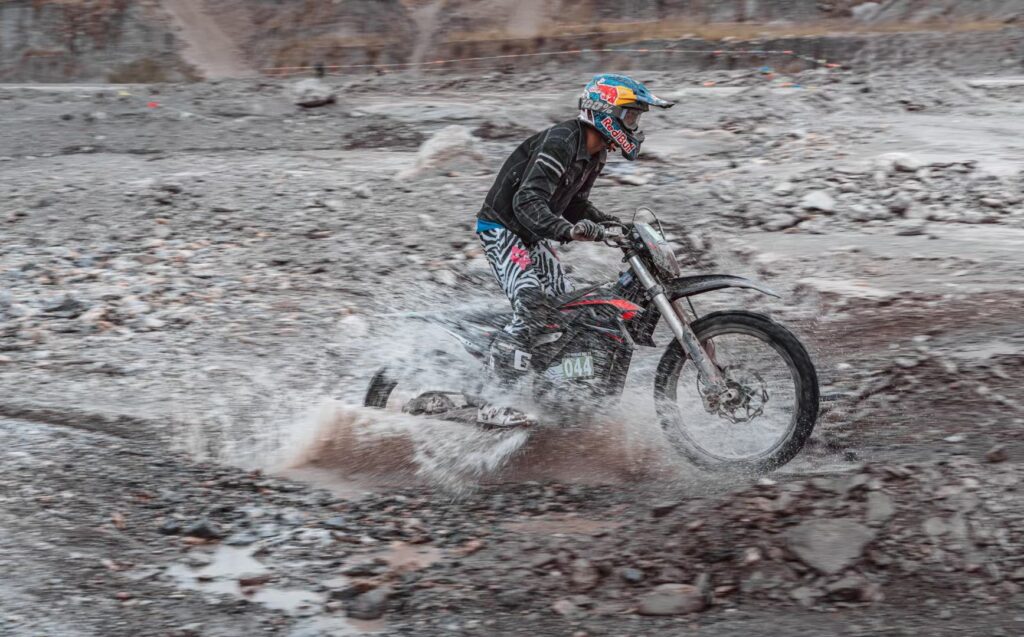

Feel the Thunder Without the Noise
Picture this: You’re standing at the edge of a trailhead in Moab, Utah, or perhaps the dense forests of the Pacific Northwest. The morning mist is still hanging low, and the only sound breaking the silence is your own heartbeat. You swing your leg over a machine that looks like it was forged in the future—sleek, aggressive, and impossibly lightweight. With a barely audible whir, you twist the throttle. Instant torque. Zero hesitation. The earth beneath your tires grabs hold, and suddenly you’re flying up a rocky incline that would make traditional riders wince. No smoke. No deafening engine roar. Just pure, unadulterated adrenaline.
Welcome to the electric revolution, my friend. And if you’re reading this in 2025, you’re arriving at exactly the right moment.
The American offroad landscape is experiencing a seismic shift. Electric offroad motorbikes aren’t just coming—they’ve arrived with a vengeance. Last year alone, electric dirt bike sales in the United States surged by 25%, and industry projections show the global dirt bike market skyrocketing from $11.86 billion in 2025 to an eye-watering $24 billion by 2035. But numbers don’t tell the whole story. What we’re witnessing is a democratization of adventure—a movement that’s making the thrill of offroading accessible to anyone who’s ever dreamed of kicking up dust on their own terms.
Whether you’re a complete novice who’s never touched a throttle or a commuting veteran looking for weekend escapism, this guide is your roadmap to joining the silent revolution. Buckle up. Your adventure starts now.
Why Electric? Why Now? The Market Speaks
Let’s cut through the noise for a second. If you’re new to the world of offroading, you might be wondering why electric bikes are suddenly everywhere. The answer is threefold: technology, accessibility, and timing.
First, the tech has matured. Remember those early electric motorcycles that felt like glorified scooters? Those days are dead and buried. Modern electric offroad motorbikes like those pioneered by TYE Moto pack 72V 60Ah battery systems delivering 4.32kWh of raw energy—enough to climb mountains, literally. With mid-mounted motors producing instant torque that would make 450cc gas bikes jealous, these machines aren’t just matching traditional dirt bikes; they’re outperforming them in ways that matter for new riders.
Which brings us to accessibility. Here’s the beautiful truth that nobody tells you: electric dirt bikes are the ultimate beginner machines. Unlike their gas-guzzling cousins with their finicky clutches, stalling engines, and temperamental throttles, electric bikes are intuitive. Twist and go. The learning curve that used to take months now takes days. As one veteran instructor put it, “If you can ride a bicycle, you’ll be able to manage an e-moto”.
The American market has responded enthusiastically. North America remains the largest offroad vehicle market globally, driven by our insatiable appetite for recreation and our vast network of trails. But here’s what’s fascinating: the demographic is diversifying. Women now account for approximately 20% of all offroad vehicle purchases—representing more than 160,000 new vehicle sales in 2024. Youth engagement is exploding, with over 120,000 youth-model ATVs and dirt bikes sold in 2023. Events like “Babes in the Dirt” in California now host over 1,500 female riders, while online communities like SheRides boast hundreds of thousands of members.
This isn’t just a trend; it’s a cultural transformation. Offroading is no longer the exclusive domain of die-hard mechanics and adrenaline junkies. It’s becoming a family activity, a social connector, and surprisingly, a gateway to environmental consciousness.
Meet Your New Best Friend: The Anatomy of a Modern E-Moto
Let me introduce you to what might be the most exciting category of vehicles on the market today: the adult electric offroad motorbike. Using TYE Moto’s flagship platforms as our reference point—because they perfectly exemplify where this technology stands in 2025—let’s dissect what makes these machines tick.
The Heart: Battery Technology That Changes Everything
At the core of every electric offroad bike lies its battery pack. TYE Moto utilizes CATL lithium cells with smart Battery Management Systems (BMS)—the same caliber of technology found in premium electric cars but optimized for the abuse of offroading. We’re talking about 72V 60Ah configurations that translate to roughly 4.32kWh of energy capacity.
What does this mean in real terms? Range anxiety—the dreaded fear of running out of juice miles from civilization—is quickly becoming a relic of the past. Depending on your riding style and terrain, modern electric dirt bikes can deliver anywhere from 35 to 70+ miles per charge. But here’s the kicker: with TYE Moto’s 60-second quick-swap battery system, you can literally replace your depleted battery with a fresh one faster than it takes your riding buddy to fill up their gas tank. Pop out, pop in, keep riding.
The batteries are IPX6 waterproof, meaning creek crossings and mud baths won’t fry your investment. And with zero emissions, you’re not just preserving the trails for future generations; you’re gaining access to riding areas where gas bikes are increasingly restricted due to noise and environmental concerns.
The Muscle: Mid-Mounted Motors and Torque Delivery
Here’s where physics becomes poetry. TYE Moto’s independently developed high-performance variable-speed motor—which has earned national patents—delivers something gas engines simply cannot: instantaneous torque. On a traditional 450cc dirt bike, you need to keep the engine screaming at high RPMs to access power. On an electric bike, twist the throttle at 0 RPM, and you get 100% torque immediately.
For beginners, this translates to confidence-inspiring control. You don’t need to master the delicate art of clutch modulation or worry about stalling in technical sections. The power is there when you need it, absent when you don’t. Many models feature multi-speed switches—allowing you to lock the bike in “Low” mode (around 16 mph) while learning, then unlock “Mid” (22 mph) or “High” (up to 50+ mph) modes as your skills progress.
And let’s talk about weight. The lightweight frame designs used by manufacturers like TYE Moto result in bikes that often tip the scales at under 150 pounds—a crucial factor for new riders who might need to pick their bike up after a tip-over (which will happen; it’s part of the learning process).
The Brains: Electronic Control Systems
Modern electric offroad bikes aren’t just mechanical marvels; they’re computers on two wheels. Advanced controllers manage everything from regenerative braking to traction control. With the E Ride Pro SR, for instance, you can connect your smartphone via Bluetooth to adjust power delivery curves, throttle sensitivity, and even limit top speed—perfect for beginners who want to grow into their machine gradually.
Your First Bike: A Buyer’s Guide for the Uninitiated
Okay, you’re pumped. You can already smell the pine needles and feel the rush of clean air. But how do you choose your first electric offroad motorbike? With prices ranging from affordable entry-level models to high-end performance machines, the options can seem overwhelming.
Size and Fit: The Golden Rules
Before you look at specs, look at yourself. The cardinal rule of beginner bike selection is this: you must be able to plant both feet flat on the ground when seated. This builds immediate confidence and provides stability when stopping on uneven terrain. For most adult beginners, bikes with seat heights between 32-36 inches work best.
Weight matters enormously. As a newbie, aim for bikes weighing between 60-70 kg (130-155 lbs). Anything heavier becomes a burden when navigating technical trails or recovering from spills. The TYE Moto philosophy of lightweight design isn’t just marketing speak—it’s a safety feature for new riders.
Power Management: Crawl Before You Ball
Here’s a counterintuitive truth: more power isn’t better when you’re learning. Look for bikes with adjustable power modes. The ability to restrict output to 3-6 kW initially, then gradually unlock the full potential (some bikes offer up to 25 kW peak), means your “starter bike” can remain your “forever bike” as you progress from tentative beginner to seasoned trail blazer.
For pure beginners, the Talaria X3 Pro or Talaria Sting represent the sweet spot—offering predictable power delivery, excellent value, and the agility to build confidence quickly. If you’re the type who wants room to grow and don’t mind using smartphone apps to tame the beast initially, the E Ride Pro SR offers extreme performance that can be electronically limited until you’re ready.
Legal Considerations: Street vs. Dirt
Critical question: Where will you ride? If you dream of dual-sport adventures—riding to the trails on public roads—you’ll need a bike with L1e or L3e homologation. L1e-classified bikes (restricted to 28 mph/45 km/h) can often be ridden with a standard driver’s license in many states, while L3e models require full motorcycle endorsement. Pure offroad bikes skip these regulations but limit you to private property and designated OHV areas.
TYE Moto’s compliance with EU CE and E-MARK certifications indicates their bikes meet stringent international safety standards—a good indicator of build quality for American buyers.
Gear Up: Dress for the Slide, Not the Ride
Let me be crystal clear: there is no compromising on safety gear. Electric bikes may be quiet and clean, but gravity works exactly the same way as on gas bikes. Before your first ride, acquire:
The Non-Negotiables:
- DOT-approved full-face helmet (not a bicycle helmet—your jaw will thank you)
- Goggles with tear-off or roll-off systems for muddy conditions
- Riding gloves for grip and blister protection
- Over-the-ankle boots (motocross-specific preferred, but sturdy work boots work initially)
- Long sleeves and pants (dedicated riding gear with armor is ideal)
The Highly Recommended:
- Knee guards or knee pads (knees are expensive to repair)
- Elbow guards
- Chest protector or armored riding jacket
Remember: You’re not dressing for Instagram (though you’ll look awesome); you’re dressing for the inevitable moment when you and the ground become intimately acquainted. The good news? Electric bikes’ smooth power delivery actually reduces the likelihood of sudden, unexpected launches that often cause beginner crashes on gas bikes.
The First Ride: From Zero to Hero
You’ve got your bike. You’ve got your gear. Your heart is hammering against your chest like a caged bird. Now what?
Location, Location, Location
For your maiden voyage, find a large, open grassy field or flat dirt lot. Avoid pavement—it’s unforgiving when you fall. Grass provides a softer landing and better confidence. Ensure you have permission to ride there; tearing up someone’s field without permission is a fantastic way to ruin the sport for everyone.
Pre-Ride Ritual
Develop the habit of the pre-ride check:
- Tires: Check pressure and inspect for damage
- Brakes: Squeeze levers—hydraulic disc brakes should feel firm, not spongy
- Battery: Ensure it’s locked in and fully charged
- Throttle: Test response with the bike stationary
- Bolts: Quick visual check that nothing is obviously loose
The Art of the Throttle
Here’s the secret that separates smooth riders from crash statistics: throttle control is everything. Electric bikes deliver instant torque, which is both their greatest feature and their biggest trap for ham-fisted beginners.
Think of the throttle not as an on/off switch, but as a volume dial. Roll it on gently, especially from a standstill. Practice “feathering”—applying tiny increments of power to maintain consistent speed over rough terrain. The goal is smooth, predictable acceleration that keeps the rear tire hooked up rather than breaking loose in a wild spin.
Start in Low/Eco mode. Resist the urge to immediately unlock full power. Spend your first few sessions simply practicing:
- Starting and stopping smoothly
- Riding in a straight line at walking pace
- Gentle turns using “look where you want to go” technique
- Emergency stops using both brakes evenly
Standing Up: The Moment Everything Clicks
Once you’re comfortable seated, it’s time to learn the fundamental offroad position: standing on the pegs. This is where electric bikes truly shine for beginners—they’re often lighter and more balanced than gas bikes, making standing easier.
Stand with knees slightly bent, elbows up and out (like you’re trying to push someone away), and grip the bike with your knees while your body remains loose and centered. This “attack position” turns your legs into secondary suspension, allowing the bike to move beneath you while you maintain control. Practice this on flat ground first, then gradually incorporate it over small bumps.
Mastering the Terrain: Skills That Pay Bills
As your confidence grows, you’ll start encountering varied terrain. Each surface demands slightly different technique:
Loose Gravel and Sand: Shift your weight back to keep the front wheel light. Maintain steady throttle—abrupt changes unsettle the bike.
Uphill Climbs: Lean forward to keep the front wheel planted. Use consistent throttle to maintain momentum. If you lose speed mid-climb, don’t panic; feather the throttle rather than grabbing a handful.
Downhill Descents: Stand up, shift weight back, and use engine braking (simply rolling off the throttle on electric bikes provides smooth deceleration). Squeeze both brakes gently rather than grabbing them.
Ruts and Roots: Stand up! Let the bike dance beneath you. Look ahead, not down—the bike goes where your eyes go.
The Social Aspect: Join the Tribe
One of the most beautiful aspects of the electric offroad community is its inclusivity. Unlike traditional dirt bike culture, which could sometimes feel intimidating to newcomers, the e-moto scene is exploding with first-time riders, families, and diverse groups.
Seek out local riding clubs or Facebook groups in your area. Attend events like “Babes in the Dirt” if you’re female-identifying, or join youth programs if you’re getting your kids involved. The AMA Youth Motocross Championship recorded over 8,000 entries across the US last year, indicating a thriving competitive scene for younger riders.
Manufacturers are investing heavily in training: Yamaha’s “Champions Riding School” and Polaris’ “Youth Ride Command” trained over 10,000 young operators in 2024. Take advantage of these resources. Riding with others not only accelerates your learning but transforms the sport from a solitary activity into a social one.
Maintenance: Simple Is Beautiful
Here’s a dirty little secret that gas bike owners don’t want to admit: electric dirt bikes are maintenance dreams. No oil changes. No air filters to clean. No carburetors to adjust. No spark plugs to replace.
Your maintenance checklist is gloriously short:
- Clean it: Hose off mud after rides (avoid high-pressure water directly on bearing seals)
- Charge it: Remove the battery and charge indoors after each ride
- Lubricate: Keep the chain lubed for smooth operation
- Inspect: Check brake pads and tire wear periodically
- Store properly: Keep the battery at around 50% charge if storing long-term
That’s it. Seriously. The time you save wrenching translates to more time riding—or more time with family, if that’s your thing.
The Future Is Electric, and It Starts With You
As we stand here in 2025, you’re witnessing the inflection point. The technology has matured. The infrastructure is growing. The community is welcoming. And the trails are calling.
Companies like TYE Moto aren’t just manufacturing bikes; they’re engineering freedom. With their patented high-performance motors, CATL battery technology, and 60-second quick-swap systems, they’ve addressed the traditional barriers that kept people out of the sport—complexity, maintenance, and intimidation.
Whether you choose a lightweight Talaria for nimble trail riding, a torque-monster E Ride Pro for technical terrain, or someday graduate to a custom Vector build for extreme adventures, your entry point has never been more accessible.
The silent revolution isn’t about replacing the roar of gas engines with the whir of electric motors—it’s about amplifying the one sound that matters most: the sound of your own heartbeat as you conquer terrain you never thought possible.
So what are you waiting for? Charge that battery. Throw your leg over the saddle. Twist the throttle.
Welcome to the future of offroading. It’s electric, it’s exhilarating, and it’s exactly what you’ve been waiting for.
See you on the trails.
Ready to start your journey? Explore TYE Moto’s range of adult electric dirt bikes and find the perfect machine to unleash your offroad potential.


