
The Electric Revolution Hitting the Dirt
For decades, the roar of two-stroke and four-stroke gasoline engines has defined the soundscape of motocross tracks and off-road trails worldwide. But times are changing. Walk through any modern riding facility today, and you might notice something peculiar—the silence. Well, not quite silence, but a distinctly different sound. The whir of electric motors is rapidly becoming the new anthem of off-road motorcycling, and with this shift comes one of the most hotly debated questions in the riding community: Are electric off-road motorbikes actually easier to ride?
The short answer? Yes, but with some important caveats that every rider should understand. To truly settle this debate, we need to dive deep into what makes these machines tick, how they compare to their gas-powered ancestors, and what industry leaders like TYEMOTO and Stark Varg are bringing to the table.
Understanding the Electric Off-Road Motorbike
Before we can judge whether electric off-road motorbikes are easier to ride, we need to understand what sets them apart. An electric off-road motorbike, often abbreviated as EORMX, is essentially a dirt bike that swaps the internal combustion engine for an electric motor and battery pack . At first glance, they look similar to traditional dirt bikes—long-travel suspension, knobby tires, aggressive geometry—but beneath the surface, everything changes.
The fundamental difference lies in power delivery. Gas engines build power progressively through RPM ranges, requiring riders to manage gears and clutch engagement to keep the engine in its optimal power band. Electric motors, by contrast, deliver maximum torque instantly from zero RPM. Twist the throttle, and you’ve got full power immediately . This characteristic alone transforms the riding experience in ways that both simplify and complicate matters, depending on the situation.
Why Electric Off-Road Motorbikes Feel Easier: The Case for Simplicity
No Clutch, No Gears, No Problem
Perhaps the most immediate advantage riders notice when switching to electric is the elimination of the clutch and gearbox. On a traditional gas-powered dirt bike, managing the clutch is a constant cognitive load—especially in technical terrain. You need to feather it for slow-speed balance, dump it for jumps, slip it for corner exits, and coordinate it with throttle and brake inputs constantly. After hours in the saddle, clutch fatigue becomes real, both mentally and physically.
With an electric off-road motorbike like the TYEMOTO TYE3000 or the Stark Varg, that entire layer of complexity vanishes . You twist, you go. This simplicity allows riders to focus their attention on line choice, body positioning, and reading terrain rather than managing mechanical systems. For beginners, this dramatically flattens the learning curve. For experienced riders, it frees up mental bandwidth to push harder and ride more precisely.
The Stark Varg EX review from Motorcycle News highlights this beautifully: “Managing gear selection is one more thing to think about, and after a few hours in the saddle, it’s easy to lose track. As the Varg EX has no clutch or gears, you can’t find yourself in the wrong gear or stall mid-corner at the worst possible moment” . That stall-proof nature alone prevents countless crashes and embarrassing moments that every gas bike rider has experienced.
Instant Torque: Friend or Foe?
Electric motors deliver torque instantly, and this changes how bikes respond to rider inputs. The TYEMOTO TYE3000 boasts over 1000 Nm of maximum torque from its 12 kW motor, while the TYE5000 pushes that to 1500 Nm with 25 kW peak power . The Stark Varg is equally impressive, delivering 275 Nm at the countershaft and a staggering 978 Nm at the rear wheel from its 80 horsepower motor .
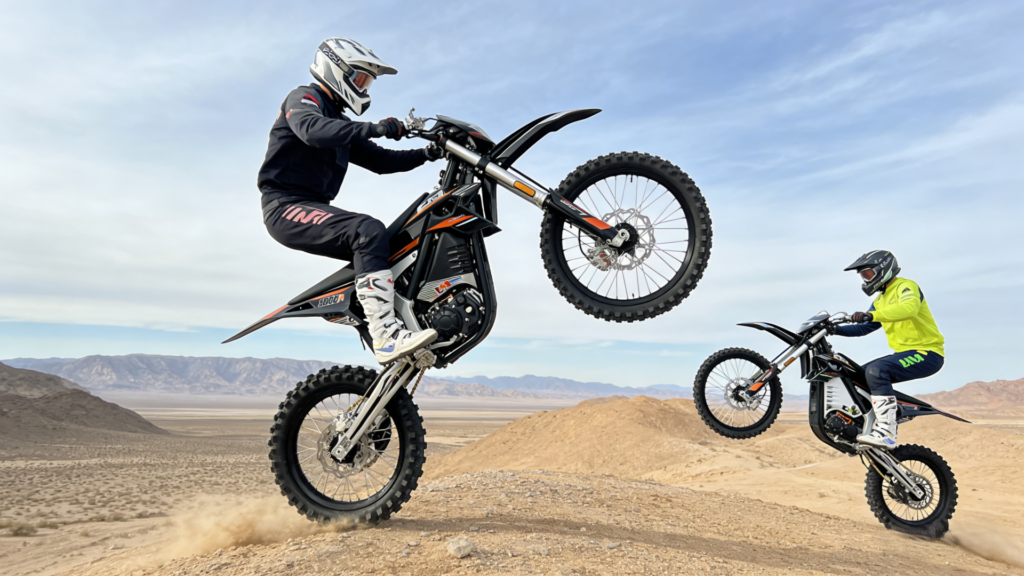
This instant torque makes certain maneuvers dramatically easier. Technical hill climbs? The power is there immediately, without waiting for the engine to spool up. Need to loft the front wheel over an obstacle? A quick blip sends the front skyward with minimal effort. Low-speed technical riding becomes more controllable because power delivery is immediate and linear.
However, this same characteristic demands respect. The sheer violence of instant torque can catch inexperienced riders off guard. Where a gas engine’s power builds progressively, giving you time to react, electric power hits immediately. Manufacturers have addressed this through sophisticated throttle mapping and ride modes, but the fundamental physics remain—electric torque is immediate, abundant, and unforgiving if misused.
Reduced Physical Fatigue
One often overlooked advantage of electric off-road motorbikes is reduced rider fatigue. Multiple factors contribute to this. First, the absence of vibration through the handlebars makes a surprising difference. Gas engines, particularly single-cylinder dirt bikes, transmit significant vibration that accelerates arm pump—the dreaded forearm fatigue that ends riding sessions prematurely .
The Stark Varg EX review notes: “With the Stark, I can muster double the seat time, at a solid pace without feeling anywhere near as fatigued” . This isn’t just about comfort; it’s about performance. Less fatigue means better concentration, better decision-making, and safer riding throughout longer sessions.
Additionally, the lower center of gravity typical of electric designs (due to battery placement low in the chassis) improves handling and reduces the physical effort required to maneuver the bike. The TYEMOTO TYE3000 weighs just 118 kg and features a “low center of gravity design and excellent suspension system” that provides a “smooth and customizable driving experience” . The Stark Varg maintains competitive weight at around 120 kg, only about 10 kg more than a comparable 450cc gas bike despite its battery pack .
Where Electric Off-Road Motorbikes Demand More Skill
Weight Distribution and Inertia Differences
While electric bikes are impressively light given their battery technology, they carry their weight differently than gas bikes. The concentrated mass of batteries creates distinct handling characteristics, particularly in the air. Gas bikes have rotating engine mass that creates gyroscopic stability and predictable inertia. Electric bikes lack this, which changes how they respond to rider inputs during jumps and in flight.
The Stark Varg addresses this through careful chassis tuning. Their testing process “helped them optimize the chassis design and control its flex for a stable and predictable ride” . The “ride’s center of gravity is positioned low, near the rider’s legs, and this placement helps distribute weight evenly” . However, riders transitioning from gas bikes often report that electric bikes feel different in the air—neither better nor worse, just different, requiring adaptation.
Throttle Precision Demands
The same instant torque that makes electric bikes exhilarating also makes them demanding. Subtle throttle inputs yield dramatic results. Where gas bikes forgive ham-fisted throttle application through their power delivery curves, electric bikes respond immediately. This rewards precision but punishes sloppiness.
The Stark Varg EX demonstrates this duality perfectly. At lower power settings (10-60 hp), the throttle connection is described as “smooth” and “vital for manoeuvres and obstacles” . But at full power (79 hp), the experience transforms: “it’s mind-bogglingly fast. It’s still soft on the initial few percent of the throttle, but letting loose that much power in such a manner for the first time is something I won’t forget. It’s bloody marvellous, in an overkill, scare yourself silly on every outing for a few minutes kind of way” .
This adjustable nature—offering anywhere from 10 to 80 horsepower at the tap of a screen—means electric bikes can be as tame or as terrifying as you configure them. The learning curve isn’t necessarily easier; it’s just different, with higher peaks and more customization.
Battery Management as a Skill
Riding electric off-road motorbikes introduces a new variable that gas bikes never demanded: energy management. Range anxiety is real, and aggressive riding dramatically reduces available distance. The TYEMOTO TYE3000 offers up to 150 km range, as does the TYE5000, but “higher ride intensity reduces range, while moderate riding extends endurance” .
Skilled electric riders learn to modulate their aggression, using full power when it matters and conserving energy when it doesn’t. This adds a strategic layer to riding that doesn’t exist with gas bikes—you can’t just fill up at any trailhead. The Stark Varg’s battery management system helps, but “strategic throttle use improves endurance riding, ensuring power remains available when needed” .
TYEMOTO vs. Stark Varg: Two Approaches to Accessible Electric Performance
To understand how different manufacturers address the ease-of-ride question, let’s compare two leaders in the space: TYEMOTO and Stark Varg.
TYEMOTO: The Practical Approach
TYEMOTO has positioned itself as a manufacturer of accessible, high-value electric off-road motorbikes. Their TYE3000 and TYE5000 models emphasize practical features that make electric riding approachable .
The TYE3000’s 60-second quick battery replacement system addresses one of electric riding’s biggest practical concerns . Run out of juice? Swap batteries faster than you could fill a gas tank. This removes a significant psychological barrier for riders concerned about range limitations.
TYEMOTO also emphasizes intelligent systems that assist riders. Their “chitu intelligent controller system” automatically “controls and adjusts the entire vehicle for optimal performance” . The standard TCS (Traction Control System) “enhances the stability of the vehicle’s driving direction” . These electronic aids effectively make the bike easier to ride by managing power delivery and preventing loss of control.
The TYE5000 takes performance up a notch with 0-100 km/h acceleration in just 4.8 seconds and a top speed of 125 km/h . Yet it maintains the approachable characteristics—two riding modes (Eco and Sport), Bluetooth connectivity for customization, and robust environmental protection with IP65 waterproofing .
TYEMOTO’s philosophy seems clear: make electric off-road motorbikes that are easy to live with, easy to ride, and accessible to a broad range of skill levels. Their bikes are powerful but wrapped in technology that helps riders manage that power.
Stark Varg: The Performance-First Philosophy
Stark Future, the Swedish manufacturer behind the Varg lineup, takes a different approach. They’ve created what many consider the first electric off-road motorbike that doesn’t just match gas bikes but surpasses them in performance .
The Stark Varg MX and EX models are unapologetically high-performance machines. The 80 horsepower output exceeds most 450cc gas bikes by a significant margin . The 275 Nm of torque at the countershaft is simply unmatched in the gas world . This is a bike designed to win races, not just introduce beginners to electric riding.
Yet Stark has also made their bikes remarkably configurable, which indirectly makes them more accessible. Riders can select power outputs from 10 to 80 hp, choose regeneration levels that simulate engine braking, and customize virtually every aspect of power delivery . The Varg MX 1.2 offers “three stock settings available that the riders can choose, depending on their weight and skill level” .
This creates an interesting paradox: the Stark Varg is simultaneously one of the most intimidating and one of the most approachable electric off-road motorbikes available. In low-power modes, it’s a gentle learning platform. In full-power configuration, it’s a weapon that demands respect.
Stark’s attention to ergonomics and customization also aids rideability. When purchasing a Varg, “the set-up is tailored to your weight, and those final tweaks are a doddle with the fully adjustable suspension” . You can “pick if you’d like tubes or mousses as well as a variety of different tyre options and compounds” . This personalization ensures the bike fits the rider, not the other way around.
The Stark Varg SM (supermoto variant) even includes design features specifically for accessibility: “integrated lift handles to help move or position the motorcycle easily” and a frame geometry that enables “wheelies on hills, streets, and roads legally” . These details show that even performance-focused electric bikes can incorporate thoughtful features that make riding more approachable.
The Verdict: Easier, But Different
So, are electric off-road motorbikes easier to ride? The evidence suggests yes, with important qualifications.
For beginners, electric bikes offer a gentler entry point. The elimination of clutch and gears removes significant cognitive load. The ability to start with reduced power settings (available on both TYEMOTO and Stark Varg models) creates a safer learning environment. The reduced vibration and physical fatigue allow longer practice sessions. The instant torque, properly managed through electronic aids, makes technical maneuvers more accessible.
For experienced riders transitioning from gas bikes, the equation changes. These riders must unlearn habits developed over years of clutch management and power band exploitation. They must adapt to different weight distribution and inertia characteristics. They must develop new instincts for throttle control given the immediate power delivery. The learning curve isn’t necessarily easier—it’s lateral, requiring adaptation rather than pure skill acquisition.
However, once adapted, most experienced riders report that electric off-road motorbikes enable higher performance with less effort. The Stark Varg EX review summarizes this perfectly: “the Stark makes riding accurately much easier, reducing physical strain in the process” . The bike doesn’t ride itself, but it removes mechanical barriers between rider intention and execution.
The Future Is Electric, and It’s Approachable
The electric off-road motorbike revolution isn’t coming—it’s here. TYEMOTO and Stark Varg represent two successful approaches to making this technology accessible: one through practical intelligence and value, the other through configurable performance that scales with rider ability.
Both approaches share common threads that make electric riding easier: simplified operation, customizable power delivery, reduced physical demands, and sophisticated electronic assistance. These characteristics don’t eliminate the need for skill, but they do remove artificial barriers that gas-powered mechanics imposed on riders.
As battery technology continues improving and costs decrease, electric off-road motorbikes will become increasingly mainstream. The debate about whether they’re easier to ride will fade, replaced by acceptance that they’re simply different—and in most measurable ways, more accessible to a broader range of riders.
The dirt doesn’t care what powers your bike. But your body, your mind, and your riding progression might just thank you for going electric. Whether you choose the practical intelligence of TYEMOTO or the performance-first philosophy of Stark Varg, you’re entering a new era of off-road motorcycling—one where the machines work with you, not against you, and where the focus returns to what matters most: the ride itself.
If you liked the article, please follow us:
Related searches for electric dirt bike