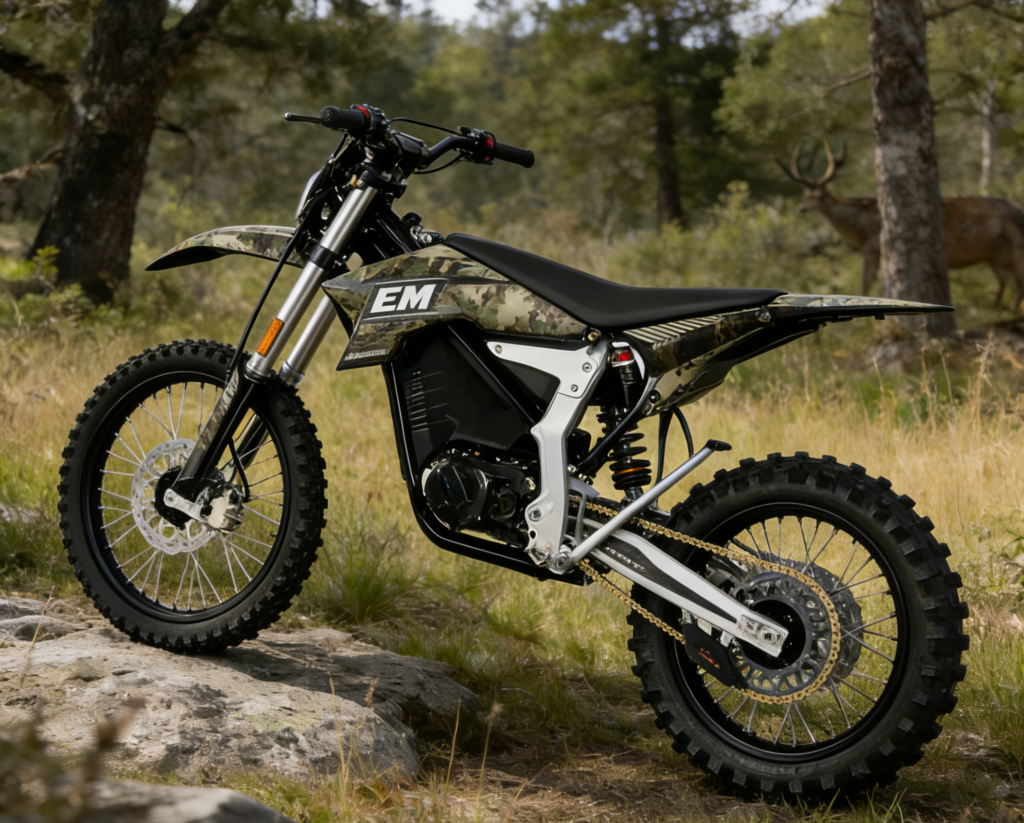

For generations, the American hunting experience has been defined by a symphony of familiar sounds: the crunch of leaves under boot, the whisper of the wind through pines, the sharp crack of a twig, and the throaty rumble of an ATV or UTV navigating a backcountry trail. But as we move into 2025, a new, profound silence is descending upon the hunting grounds, heralding a technological revolution that is changing the very nature of the pursuit. The electric dirt bike, once the domain of motocross enthusiasts and trail adventurers, has been re-engineered, re-purposed, and re-imagined. It is now the cutting-edge tool for the modern adult hunter, offering a blend of stealth, performance, and environmental mindfulness that is reshaping strategies and successes from the Alaskan tundra to the Texas hill country.
This is not merely about swapping a gas engine for a battery. It is a fundamental shift in the hunting paradigm. The hunting electric dirt bike represents a convergence of advanced battery technology, high-torque electric motors, and purpose-built hunting accessories, creating a platform that addresses some of the most persistent challenges hunters face. Let’s delve into the science, the strategy, the market, and the future of this silent revolution.
The Science of Silence and Power: Engineering the Ultimate Hunting Machine
At its core, the advantage of an electric dirt bike for hunting boils down to physics and perception.
1. The Stealth Factor: Acoustics and Olfaction
A traditional gas-powered dirt bike or ATV is, acoustically, a broadcasting beacon. Its internal combustion engine produces a broad spectrum of noise—low-frequency rumbles that travel long distances and higher-frequency mechanical noises that alert game to unnatural danger. Wildlife, particularly big game like deer, elk, and bear, have exceptional hearing tuned to detect these anomalies.
An electric dirt bike’s motor produces a near-silent hum or whine, typically below 60 decibels at cruising speed. This is quieter than a normal conversation. The dominant sound becomes the shhh of tires on terrain. This allows hunters to:
- Approach zones undetected: Ride much closer to potential game areas without spooking animals miles away.
- Stop and listen: Kill the “engine” instantly and become part of the ambient soundscape, allowing for immediate glassing or listening for animal movement.
- Reduce olfactory intrusion: Gas engines produce exhaust fumes—a strong, unnatural scent that can linger on trails and alert an animal’s primary sense: smell. Electric bikes produce zero local emissions, leaving no petrol scent plume.
2. The Instant Torque Advantage: Newton’s Laws for the Backcountry
Electric motors deliver 100% of their available torque from zero RPM. This translates to instantaneous, controllable power for the hunter:
- Technical Terrain Mastery: Precise, low-speed crawling over rocks, through mud, or up steep, slick inclines is more manageable. The rider can modulate power with millimeter precision via the throttle, without stalling.
- Quick, Quiet Getaways: If needed, immediate acceleration is available without the roar and clutch-fanning of a gas bike.
- Regenerative Braking: Many models feature regen, which slows the bike while charging the battery on descents, extending range and reducing brake wear—a crucial feature in mountainous terrain.
3. The Energy Equation: Batteries, Range, and “The Zap”
The single biggest question from hunters is: “Will it get me there and back on a single charge?” For 2025, the answer is a confident “yes” for most scenarios, thanks to lithium-ion and emerging solid-state battery packs.
- Capacity: Modern hunting e-bikes boast capacities from 2.5 kWh to over 7 kWh. Real-world range varies dramatically with weight, terrain, and speed, but 40-80 miles of mixed off-road travel is now standard.
- The “Camp Charger” Strategy: The true hunter’s edge comes from portable solar panels or lightweight, high-output generators. A hunter can ride 20 miles deep into a wilderness area, set up a spike camp, and use a foldable 200-watt solar blanket to recharge the bike over a day of glassing. This enables multi-day, deep-backcountry hunts without reliance on gas.
- Swappable Packs: Some manufacturers are offering dual or swappable battery systems. One battery can be charging at camp while the other is in use.
The 2025 Market: Purpose-Built Hunting Machines
The market has evolved from generic electric dirt bikes to models specifically marketed and accessorized for the hunter. Key players and trends for 2025 include:
1. The “Quiet Power” Segment (Specialized Brands):
- Stealth Electric Bikes / HUNT: Arguably the pioneer, this brand builds bikes from the ground up for hunting. Features include ultra-quiet gearing, camouflage wraps, integrated gun/bow scabbards (like the “Arrowhead” bow carrier), and tow-behind game carts. Their frames are designed for low-speed balance and high load capacity.
- Bulto Brinco / Kuberg: These European-derived “trials” style bikes offer incredible torque and slow-speed control, perfect for navigating tight, technical woods. They are increasingly accessorized for the US hunting market.
2. The “Mainstream Performance” Segment (Adapted MX/Enduro):
- Sur-Ron Light Bee / Storm Bee: The Sur-Ron has become a ubiquitous platform due to its modifiability. Hunters add their own racks, scabbards, and larger aftermarket batteries. The new Storm Bee, with its more motorcycle-like power and size, is gaining traction for open-country hunts.
- KTM Freeride E-XC / Stark Varg: These are high-performance, lightweight machines from established motorcycling giants. While premium-priced, they offer unmatched suspension and power for hunters who need to cover vast, rough territory quickly. Accessorizing is required.
3. Key Hunting-Specific Features for 2025:
- Integrated Weapon Carriage: Locking, vibration-dampened scabbards for rifles or bows that maintain the bike’s narrow profile.
- Game Recovery Systems: Heavy-duty rear racks and hitch points for pulling game carts or securing quartered bags. Some models have small, electric winches.
- “Walk-Assist” Mode: A crucial function that allows the hunter to walk alongside the bike at 1-3 mph, using the motor to push the loaded bike effortlessly back to camp after a successful harvest.
- Advanced Displays: GPS integration, remaining range mapping based on terrain, and compatibility with hunting apps like onX Hunt.
- Thermal & Night Vision Readiness: Built-in accessory rails and 12V/USB power ports for mounting thermal scopes or helmet-mounted night vision for predator hunting or low-light recovery.
The Strategic Hunter: New Tactics for the Electric Age
The electric dirt bike isn’t just a new vehicle; it’s a new tool that demands new tactics.
- The Silent Infiltration: Instead of parking a loud truck miles away and hiking in, hunters can ride silently to within a few hundred yards of a target meadow or wallow, preserving energy for the hunt itself.
- Adaptive Mobility: They enable rapid, quiet movement between glassing points or hunting zones based on wind changes or animal movement patterns spotted via binoculars.
- The “One-Man Pack-Out”: The most grueling part of a successful hunt—packing out hundreds of pounds of meat—is transformed. The bike, using walk-assist or low-speed towing, can haul what would take a human multiple exhausting trips.
- Access to New Areas: Their narrow profile allows them to travel on single-track trails inaccessible to full-size ATVs or UTVs, opening up previously overlooked pockets of public land.
Navigating the Gray Area: Regulations and Ethics for 2025
This new technology exists in a regulatory gray area that hunters must navigate responsibly.
- Vehicle Classification: In most states, electric dirt bikes are not titled as motorcycles or ATVs if they fall under a certain power rating (e.g., cannot exceed 28 mph on pavement). They may be classified as “electric bicycles” or “off-road recreational vehicles.” This varies dramatically by state and land jurisdiction.
- Land Access Rules: This is paramount. On public lands (BLM, National Forests), you must follow specific regulations for “motorized vehicles.” Electric bikes are almost always considered motorized. They are typically restricted to established roads and trails designated for motorcycle/ATV use. Cross-country travel is usually prohibited. Never assume an e-bike is allowed where a gas bike is not. Always check with the local land management agency.
- Road Use: Most are not street-legal unless specifically modified with DOT-approved lights, mirrors, and a license.
- The Ethical Imperative: The very stealth that provides an advantage also raises ethical questions. Fair chase remains paramount. Using the bike’s silence to run down animals is unethical and illegal. The consensus among responsible hunting e-bikers is: The bike is for access and recovery, not for the stalk or the kill. It gets you quietly to your hunting area, after which you proceed on foot using traditional skills.
Choosing Your Machine: A 2025 Buyer’s Considerations
For an adult hunter looking to enter the electric realm in 2025, here’s the decision matrix:
- Terrain & Game: Tight eastern woodlands for whitetail? A light, torquey trials-style bike (Bulto, Stealth) excels. Vast western basins for elk? A longer-range, higher-speed performance bike (Stark, modified Sur-Ron Storm) may be better.
- Range Anxiety: Calculate your typical deepest-in access distance and double it for safety. Invest in a portable charging solution.
- Load Needs: Will you need to carry a cooler, camp gear, and haul out an elk? Prioritize bikes with robust frames, high torque, and strong accessory ecosystems.
- Budget: Entry-level modifiable bikes start around $4,500. Purpose-built hunting bikes range from $8,000 to $12,000. High-performance models like the Stark Varg approach $15,000.
The Future of the Hunt: Sustainability and Community
The rise of the hunting electric dirt bike aligns with a broader trend in the outdoor community: a focus on conservation and low-impact recreation.
- Environmental Stewardship: They reduce noise pollution in wild spaces and have zero operational emissions, appealing to a new generation of environmentally conscious hunters.
- Landowner Relations: Their quiet nature makes them more welcome on private lands, as they cause less disturbance to livestock, wildlife, and the landowner’s peace.
- Building Community: Online forums and YouTube channels dedicated to e-bike hunting are exploding, sharing mod ideas, field-test results, and success stories, fostering a new subculture within hunting.
Conclusion: The Sound of the Future
As dawn breaks over a Montana ridge in 2025, a hunter switches off his electric dirt bike. The last faint hum fades into the stillness. He hears an elk bugle in the distance, a sound that would have been masked or preemptively silenced by the arrival of a gas-powered machine. He dismounts, retrieves his rifle from its integrated scabbard, and begins his stalk on foot, his senses heightened, his energy preserved, and his impact minimized.
The hunting electric dirt bike is more than a gadget; it is a paradigm shift. It represents a fusion of cutting-edge technology with the ancient ethos of the hunt. It offers a solution to practical problems while challenging hunters to be more thoughtful, more strategic, and more in tune with the environment they operate in. It is not replacing skill; it is augmenting possibility. In the profound and strategic silence it provides, hunters are rediscovering the sounds of the wild—and finding more success in the process. The revolution is here, and it is whisper-quiet.
if you liked the article, please follow us:
Related searches for electric dirt bike