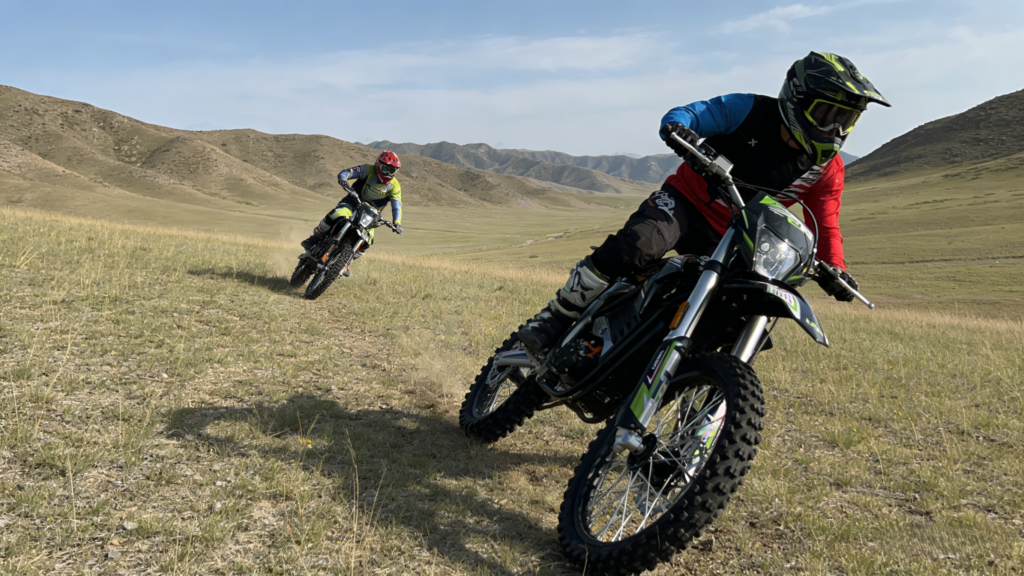

The adult electric enduro dirt bike is not simply a combustion enduro with a battery bolted where the fuel tank used to be. Enduro riding—steep loose climbs, root-infested technical descents, water crossings, and hours of sustained abuse—places a unique and unforgiving set of demands on every system. An electric platform that looks competitive on a spec sheet can unravel on the trail if it lacks the features that make electrification an advantage rather than a compromise. What follows are the seven non-negotiable characteristics that separate a genuinely capable Adult Electric Enduro Dirt Bike from an electric playbike wearing enduro bodywork.
1. A Battery Architecture Built for “Energy Logistics,” Not Just Capacity
The single most consequential feature of an electric enduro bike is not how many kilowatt-hours its battery holds. It is how quickly and practically that energy can be replenished or replaced when the ride does not stop at a charging station.
A large, fixed battery creates a dependency on charging infrastructure that simply does not exist on a remote enduro loop. Even the fastest DC fast-charging curve imposes a mandatory halt measured in tens of minutes, which is an eternity in a race or a group ride. The solution is a genuinely rapid, tool-free battery swap architecture. Radian’s EXR, for example, uses a dual-module InfiniPack system that the company claims can be removed and replaced in under 30 seconds without tools, with each module weighing approximately 22 kg. The curved, pull-and-lift geometry is not cosmetic: it allows a single rider to execute the swap trailside and simultaneously positions the mass low and central for handling. KTM has moved in the same direction with the 2027 Freeride E, equipping it with a 5.5 kWh removable pack designed to be exchanged for a fresh unit when longer sessions are required.
The practical implication is a shift in how range is conceived. A 60–115 km off-road range figure is useful information, but it becomes far more useful when it is paired with the ability to carry a second set of modules in a support vehicle or even integrated subframe storage and effectively double the riding window without waiting for a charger. An Adult Electric Enduro Dirt Bike without a credible swap pathway is still, in a fundamental sense, tethered.
2. Torque Mapping and Traction Intelligence That Turn Instant Response into Control
Electric motors deliver torque from zero rpm, and that is precisely why raw torque figures can be misleading. An enduro bike needs the opposite of a light-switch power delivery: it needs the ability to shape torque so that the rear wheel hooks up on wet roots, slick clay, and loose shale rather than breaking traction and upsetting the chassis.
The defining feature here is not peak kilowatts; it is the programmability of the torque curve and the presence of terrain-aware traction control. Modern platforms allow riders to draw custom throttle maps, adjust off-throttle engine braking, and select traction control interventions that monitor rear-wheel slip and modulate power delivery accordingly. Segway’s Xaber 300, for instance, offers a Pro Mode in which the rider can create custom throttle profiles and set the energy recovery level independently, while its terrain-adaptive traction control can be adjusted through a smartphone app. Stark’s Varg has received over-the-air updates that add traction control algorithms capable of managing grip from pavement to wet roots.
This is a genuine departure from combustion enduro logic. On a carbureted or even fuel-injected gas bike, the rider manages traction primarily through clutch modulation and throttle discipline. An electric enduro bike that exposes the same level of tunability through software gives the rider a second layer of control—one that can be changed for a mud section in the morning and a dry, hard-packed climb in the afternoon without touching a wrench.
3. Enduro-Specific Suspension Travel and Geometry, Not Compromised Trail-Bike Numbers
Electric dirt bikes frequently advertise “full suspension,” but the numbers reveal whether the bike is designed for enduro or for gentle fire-road exploration. Serious enduro use demands at least 200 mm of travel at both ends, and competition-focused machines push well beyond that threshold. The Radian EXR specifies 300 mm front and rear via KYB closed-cartridge and shock units. Bonnell’s 805 platform offers 285 mm in Enduro configuration and up to 310 mm front / 320 mm rear in its Race setup. Entry-level electric bikes with 160–170 mm of travel will bottom out on drops and G-outs, transferring the impact to the frame and the rider.
Travel alone, however, is insufficient. The geometry must also suit enduro’s standing-oriented, weight-forward riding posture. A 21-inch front / 18-inch rear wheel pairing is the established enduro standard because the larger front hoop rolls over obstacles and the 18-inch rear provides a taller sidewall for pinch-flat resistance and compliance. An Adult Electric Enduro Dirt Bike that substitutes motocross geometry or smaller trail-bike wheels will feel precise on a groomed track and treacherous on a rock garden.
4. Low Unsprung Mass and a Mass-Central Chassis
Electric powertrains create a tempting packaging shortcut: mount the motor in the rear hub. For an enduro bike, this is a fundamental error. Hub motors add their mass directly to the unsprung weight that the suspension must control every time the wheel strikes a rock or root, degrading traction and rider confidence. The correct architecture places the motor inboard, driving the rear wheel through a chain or belt, so that the suspension responds to terrain rather than fighting the inertia of the drive unit.
Equally important is where the battery mass sits. A mid-drive layout allows the battery, motor controller, and motor to be arranged in a compact, three-layer stack that centralizes mass and minimizes the polar moment of inertia. KTM’s 2027 Freeride E hinges its chrome-molybdenum steel frame on the battery and drivetrain architecture specifically to achieve a low center of gravity and a slim, lightweight chassis feel. The practical result is a bike that flicks through tight singletrack and changes direction without the ponderous, top-heavy sensation that afflicts electric conversions with a battery box perched high in the old fuel-tank cavity.
5. Thermal Management Treated as a Performance Envelope, Not an Afterthought
Enduro is a sustained-power discipline. A steep, loose climb can demand near-peak output for 30 to 60 seconds at a time, and a technical section may require repeated high-torque bursts with minimal airflow. Under those conditions, heat becomes the primary limiter of performance and, eventually, the primary wear mechanism. An Adult Electric Enduro Dirt Bike without active thermal management will derate power precisely when the rider needs it most.
The feature to demand is a cooling system that treats the battery, inverter, and motor as a managed thermal system. Liquid-cooled motors are increasingly common in serious machines, with Husqvarna claiming that water cooling of its electric off-road motor delivers approximately 30% more running time through more consistent motor temperatures. Battery management systems must monitor cell temperatures and limit output to protect pack life, while the controller and motor require their own heat-rejection path. Some designs go further, using a single radiator with thermoelectric elements to distribute cooling capacity dynamically between the battery and the motor as conditions dictate. The rider-facing consequence is simple: a bike with robust thermal management delivers its claimed power for the duration of the climb, not for the first twenty seconds of it.
6. Regenerative Braking Calibrated as a Traction and Energy Tool
Regenerative braking on an electric enduro bike is often marketed as a range extender. Its more important function is as a riding control. On a loose, steep descent, the way the rear wheel decelerates—and whether that deceleration is smooth enough to maintain tire contact—has a profound effect on stability and cornering setup. Crude or non-adjustable regeneration can feel like a light switch, unsettling the chassis mid-corner or breaking traction on a wet root.
The feature that matters is multi-level, rider-selectable regeneration that can be mapped to the terrain and even linked to specific ride modes. KTM’s Freeride E offers three recuperation settings—OFF, MID, and HIGH—that can be assigned against different power modes. Talaria’s Komodo uses a four-level adjustable regenerative braking system controlled via a handlebar button, giving the rider an active tool for managing traction and energy recovery in real time. On a technical descent, a well-calibrated high-regen setting can approximate the engine-braking stability of a four-stroke while recovering usable energy; on a fast, loose section, reducing regen may be preferable to avoid rear-wheel skip. The key is that the rider—not a fixed factory calibration—decides.
7. Environmental Sealing and Component Durability Rated for Real Enduro Conditions
Enduro bikes cross streams, plough through mud, and are repeatedly dropped on rocks. An electric powertrain introduces high-voltage connectors, a battery enclosure, a motor, and a controller—each of which becomes a potential failure point if sealing is inadequate. A machine that is merely “water-resistant” is not an enduro machine.
The baseline for a credible Adult Electric Enduro Dirt Bike is IP67-level sealing for the battery, motor, and critical connectors. KTM rates the Freeride E’s motor as water- and dust-resistant to IP67, and Husqvarna states that the battery and connected components on its Pioneer are fully dustproof and waterproof at the same rating. At the upper end, some hard-enduro electric platforms claim IP67/IP68 resistance sufficient for full submersion in water or mud without interruption. This is not a comfort feature. A failed seal on a stream crossing can end a ride instantly, and corrosion in a high-voltage connector is a safety concern, not merely an inconvenience.
The Synthesis: What the Seven Features Reveal
These seven characteristics are not a checklist of independent specifications. They form an interlocking engineering argument. A rapid-swap battery is only useful if the chassis packaging allows the modules to be handled and if the mass is positioned for handling. Programmable torque and traction control are only effective if the suspension and chassis can put the resulting force to the ground without upsetting the bike. Thermal management determines whether the programmable power is available for the duration of the climb, and sealing determines whether the system survives the water at the bottom of it.
The mature Adult Electric Enduro Dirt Bike is therefore best understood not as an electric motorcycle in the generic sense, but as an energy-managed, software-tuned, terrain-specific machine. The features that matter most are the ones that convert the intrinsic strengths of electric drive—instant torque, precise controllability, quiet operation—into enduro-usable performance without importing the weaknesses of poor packaging, inadequate cooling, or fragile sealing. A buyer who evaluates an electric enduro against these seven criteria will be looking past the peak-power headline and toward the engineering that determines whether the bike is still performing at hour three, on the steepest climb of the day, with a fresh battery clicked into place.


