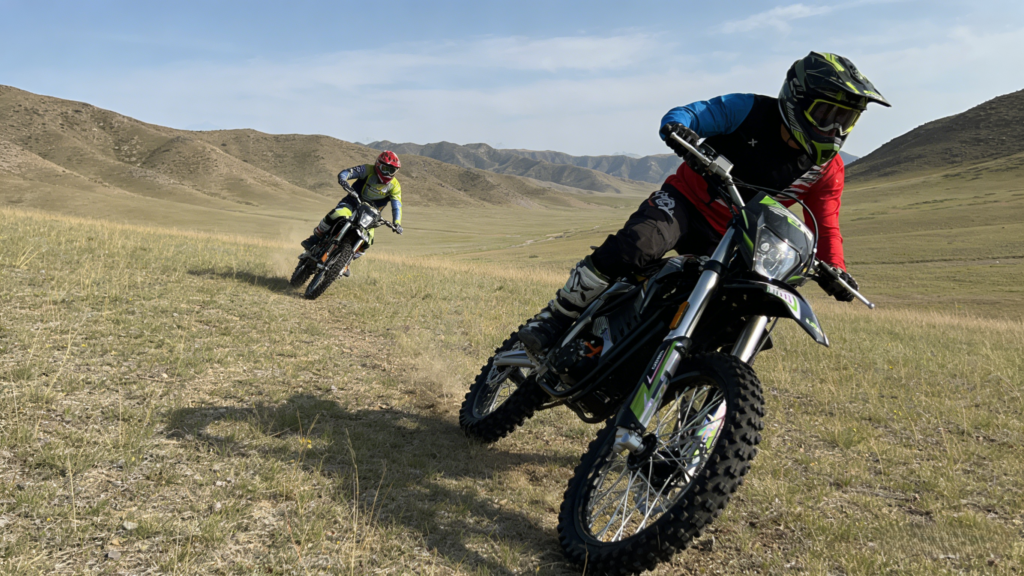

Introduction: The Silent Revolution
The off-road motorcycling landscape is undergoing a profound transformation. What was once defined by the thunderous roar of two-stroke and four-stroke engines is now being reshaped by machines that whisper across trails while delivering explosive performance. Electric off-road motorcycles have moved from experimental curiosities to legitimate performance machines, challenging and often surpassing their gasoline-powered predecessors in ways that were unimaginable just a decade ago.
At the heart of this revolution lies a fundamental shift in how we measure and understand motorcycle performance. Riders accustomed to cubic centimeters (cc), horsepower figures, and exhaust notes must now navigate a new vocabulary of kilowatts (kW), kilowatt-hours (kWh), and Newton-meters (Nm) of torque. These specifications tell a different story—one of instant power delivery, remarkable efficiency, and unprecedented control.
This article demystifies the key technical specifications of electric off-road motorcycles, using the TYE3000 and TYE5000 from TYEMoto as practical case studies. By understanding what these numbers mean in real-world riding conditions, you’ll be equipped to evaluate electric off-road machines with the same confidence you once reserved for traditional gas bikes.
Understanding kW: The New Horsepower
What is a Kilowatt?
Kilowatts (kW) measure the power output of an electric motor, serving as the direct equivalent to horsepower in traditional engines. One kilowatt equals approximately 1.34 horsepower, making conversions straightforward for riders transitioning from gas-powered machines. However, the way electric motors deliver their rated kW differs dramatically from combustion engines, creating performance characteristics that raw numbers alone cannot capture.
For electric off-road motorcycles, two kW figures matter: nominal (continuous) power and peak power. Nominal power represents what the motor can sustain indefinitely without overheating, while peak power indicates the maximum output available for short bursts—typically 10 to 30 seconds. This dual rating system reflects the thermal management challenges of electric motors and the burst-intensive nature of off-road riding.
TYE3000: The Balanced Performer
The TYE3000 exemplifies how thoughtful power calibration creates a versatile off-road machine. Its 12 kW peak power (equivalent to approximately 16 horsepower or 29.5 HP in alternative measurement standards) positions it as a capable performer across multiple disciplines.
What makes the TYE3000’s power delivery noteworthy is its mid-drive brushless DC motor with integrated four-speed gearbox. Unlike hub motors that place weight in the wheels, the mid-drive configuration centralizes mass, preserving the nimble handling characteristics that off-road riders demand. The gearbox—with gears 0 through 4 plus reverse—allows riders to optimize torque multiplication for different terrain conditions, much like traditional motorcycles.
In practical terms, the TYE3000’s 12 kW translates to a 0-100 km/h acceleration time of 4.8 seconds and a top speed of 125 km/h (78 mph). These figures place it firmly in the performance territory of 250cc four-stroke gas-powered enduro bikes, making it suitable for trail riding, enduro competition, and even motocross-style riding.
TYE5000: Unleashing Maximum Power
For riders seeking uncompromising performance, the TYE5000 demonstrates how electric power scales to compete with the most aggressive gas-powered machines. Its 20 kW brushless direct current (BLDC) motor delivers approximately 26.8 horsepower, with peak outputs reaching the full 20,000 watts.
The TYE5000 employs a single-speed direct drive system rather than a multi-speed gearbox. This design choice eliminates shifting entirely, allowing riders to focus purely on line selection and throttle control. The direct drive’s simplicity also reduces mechanical complexity and maintenance requirements—a significant advantage for competitive riders and adventure tourers alike.
Performance metrics for the TYE5000 are striking: 1,200 Nm of maximum wheel torque, 0-100 meters in 4.8 seconds, and a top speed of 125 km/h (77.6 mph). The torque figure deserves particular attention—1,200 Nm at the wheel represents forces that would challenge the traction limits of most off-road tires, enabling explosive acceleration and the ability to climb gradients that would stall lesser machines.
kW Comparison: Electric vs. Gas Equivalents
Understanding how electric kW ratings translate to familiar gas bike performance helps riders make informed comparisons:
| Electric Motor Power | Common Gas Bike Equivalent | Best Applications |
|---|---|---|
| 12-15 kW | Entry-level 250cc four-stroke | Trail riding, novice riders, technical terrain |
| 20-25 kW | High-performance 250cc to 450cc four-stroke | Enduro, motocross, aggressive trail riding |
| 30+ kW | 450cc motocross and beyond | Professional racing, extreme terrain |
The TYE3000’s 12 kW places it in the entry-to-mid performance category, while the TYE5000’s 20 kW pushes into territory traditionally dominated by larger displacement machines.
Understanding kWh: The Fuel Tank of the Future
What is a Kilowatt-Hour?
If kilowatts measure power (the rate of energy use), kilowatt-hours (kWh) measure energy capacity—the total amount of electricity stored in the battery. Think of kWh as the electric equivalent of gallons or liters of fuel. A motorcycle with a larger kWh capacity can travel farther or sustain higher power outputs longer, just as a larger gas tank extends range.
Battery capacity in electric off-road motorcycles is determined by two factors: voltage (V) and ampere-hour (Ah) capacity. Multiplying these values yields watt-hours (Wh), which convert directly to kWh by dividing by 1,000. For example, a 72V battery with 60Ah capacity stores 4,320 Wh, or 4.32 kWh.
TYE3000 Battery Architecture
The TYE3000 utilizes a 72V lithium-ion battery system with CATL cells, offering configurable capacity options of 40Ah, 50Ah, or 60Ah. The standard 60Ah configuration provides:
- Total energy capacity: 72V × 60Ah = 4,320 Wh (4.32 kWh)
- Peak output current: 300A (enabling massive instantaneous power delivery)
- Continuous output current: 150A (sustained high-performance riding)
- Charging time: 3-4 hours to full charge
- Range: 93 miles (150 km) under optimal conditions
The use of CATL cells—among the most respected in the electric vehicle industry—ensures high energy density, thermal stability, and long cycle life. The Smart Battery Management System (BMS) monitors cell health, balances charging across individual cells, and protects against overcharging, deep discharge, and thermal runaway.
A standout feature of the TYE3000’s battery design is removable battery packs that can be swapped in approximately 60 seconds. This enables extended riding sessions with spare batteries, effectively eliminating range anxiety for dedicated riders.
TYE5000 Battery Configuration
The TYE5000 takes battery technology further with options for 60Ah or 73Ah capacities at the same 72V architecture. The larger 73Ah configuration yields:
- Total energy capacity: 72V × 73Ah = 5,256 Wh (5.26 kWh)
- Range: Up to 150 km (93 miles)
- Charging time: 3-4 hours
The TYE5000’s battery also features Bluetooth-connected Smart BMS, allowing riders to monitor battery status, health metrics, and charging progress through smartphone applications. This connectivity transforms battery management from guesswork into precise, data-driven decision making.
Real-World Range Considerations
While manufacturer range figures provide useful benchmarks, actual riding range varies dramatically based on:
- Riding style: Aggressive throttle use and frequent acceleration consume more energy
- Terrain: Steep climbs and technical sections demand higher power outputs
- Rider weight and cargo: Additional mass increases energy consumption
- Temperature: Extreme cold reduces battery efficiency
- Power mode selection: Eco modes extend range; Sport modes maximize performance
The TYE3000 and TYE5000 address this variability through multiple riding modes. The TYE5000 explicitly offers Eco and Sport modes, with Sport mode delivering an additional 10% acceleration boost at the cost of increased energy consumption. This flexibility allows riders to optimize for either maximum range or maximum performance depending on their immediate needs.
Understanding Torque: The Electric Advantage
What is Torque?
Torque, measured in Newton-meters (Nm), represents rotational force—the “twisting power” that turns the rear wheel and propels the motorcycle forward. While horsepower determines top speed potential, torque determines how quickly a motorcycle accelerates from rest, how effectively it climbs hills, and how responsively it reacts to throttle inputs.
For off-road riding, torque is arguably more critical than top speed. Technical terrain demands precise power application at low speeds, steep climbs require massive pulling force, and slippery conditions reward smooth, controllable torque delivery.
The Electric Torque Revolution
Electric motors possess a fundamental advantage over combustion engines in torque delivery. An electric motor produces 100% of its rated torque instantly from 0 RPM—from a complete standstill. There is no need to build engine speed, no clutch slipping to find the power band, no downshifting to maintain momentum.
This instant torque delivery transforms the riding experience in several ways:
- Explosive corner exits: Full power the moment you crack the throttle
- Effortless hill climbs: Maximum pulling force from the base of any incline
- Precise technical control: Linear, predictable power without unexpected surges
- Reduced rider fatigue: No clutch modulation or gear management in challenging sections
Gas engines, by contrast, must spin up through their RPM range to reach peak torque, creating a power lag that demands skillful clutch and throttle coordination to manage.
TYE3000 Torque Characteristics
The TYE3000 delivers 1,000 Nm of peak torque at the wheel. This figure, achieved through the combination of motor torque and gearbox multiplication, represents forces comparable to or exceeding those of 450cc motocross machines.
The four-speed gearbox plays a crucial role in torque management. By selecting appropriate gears, riders can optimize how this massive torque reaches the ground—lower gears for technical climbing and higher gears for speed sections. This mechanical torque multiplication, combined with the motor’s instant response, creates a machine that feels simultaneously more powerful and more controllable than its specifications might suggest.
TYE5000 Torque Dominance
The TYE5000 pushes wheel torque to extraordinary levels with its 1,200 Nm maximum. This figure, delivered through the single-speed direct drive, demonstrates how electric powertrains can achieve torque outputs that would require complex, heavy multi-cylinder engines in the gas-powered world.
The direct drive system presents an interesting engineering challenge: without gears to multiply torque, the motor itself must generate enormous forces, or the system must use internal reduction gearing. The TYE5000’s solution delivers massive wheel torque while maintaining the simplicity and reliability benefits of single-speed operation.
For riders, 1,200 Nm translates to:
- Unstoppable climbing ability: Gradients that challenge traction rather than power
- Instantaneous acceleration: Wheelspin becomes the limiting factor, not engine response
- Effortless technical riding: Obstacles are cleared with minimal momentum buildup
Torque and Traction Management
The challenge of managing extreme torque in off-road conditions has driven innovations in electronic control systems. Both the TYE3000 and TYE5000 incorporate sine wave controllers that modulate power delivery with exceptional precision.
Sine wave controllers, compared to older square wave designs, provide:
- Smoother power delivery: Reduced jerky acceleration
- Higher efficiency: Less energy lost as heat
- Quieter operation: Reduced motor whine
- Better low-speed control: Essential for technical terrain
The TYE5000’s intelligent variable frequency controller further refines this with “large starting torque, fast and stable acceleration, and more linear, silent operation.” These electronic systems effectively act as intelligent intermediaries between the rider’s right hand and the motor’s immense torque potential, making extreme performance accessible without requiring extraordinary rider skill.
The Complete System: How Specs Work Together
Power-to-Weight Ratio
Raw power figures tell only part of the story. The TYE3000’s 260 lbs (118 kg) curb weight combined with 12 kW yields a power-to-weight ratio that competes favorably with gas-powered equivalents. The TYE5000 maintains similar weight discipline despite its substantially more powerful motor, preserving agile handling characteristics.
Weight distribution matters equally. Both models employ 6061 forged aluminum alloy frames with Q345B metal reinforcement, placing the heavy battery and motor mass low and centralized. This contrasts with gas bikes, where engine, fuel, and exhaust systems create more complex weight distributions.
Thermal Management
Sustained high-power operation generates heat in both motors and batteries. The TYE3000’s continuous output current of 150A versus peak current of 300A reflects thermal limitations—brief bursts of maximum power are possible, but sustained operation must respect cooling capacity.
The TYE5000’s direct drive system, with fewer mechanical losses, may offer improved thermal efficiency, though its higher absolute power demands similarly sophisticated thermal management. Both models rely on passive cooling and intelligent power limiting to protect components.
Regenerative Braking
While not explicitly detailed in available specifications, modern electric motorcycles typically incorporate regenerative braking systems that recover energy during deceleration. This feature:
- Extends effective range: Recapturing energy otherwise lost to brake heat
- Reduces brake wear: Decreased reliance on mechanical brakes
- Provides engine braking feel: Familiar deceleration characteristics for gas bike converts
Riding the Specifications: Real-World Performance
Trail Riding
For typical trail conditions—mixed terrain with varying elevation, obstacles, and speeds—the TYE3000’s specifications prove ideally balanced. Its 12 kW provides ample power for any reasonable trail challenge, while the four-speed gearbox allows riders to select appropriate torque multiplication. The 93-mile range covers full day rides for most riders, and the removable battery system enables multi-day adventures with spare packs.
The near-silent operation transforms the trail experience. Riders report heightened awareness of surroundings, reduced wildlife disturbance, and the ability to ride in noise-sensitive areas previously inaccessible to gas-powered machines.
Motocross and Aggressive Riding
The TYE5000’s 20 kW and 1,200 Nm torque position it for the most demanding riding styles. The single-speed direct drive eliminates shifting distractions during intense motocross laps, while the Sport mode’s additional 10% acceleration boost provides competitive edge.
The challenge becomes managing traction rather than generating power—modern off-road tires and electronic traction control systems must work in concert with the motor’s immense torque potential.
Endurance and Adventure
For riders covering significant distances, the relationship between kWh capacity, kW consumption, and terrain becomes critical. The TYE5000’s larger battery option (73Ah/5.26 kWh) extends range, but aggressive use of 20 kW peak power can deplete reserves rapidly. Eco mode optimization, terrain selection, and strategic battery swapping transform electric adventure riding from theoretical possibility to practical reality.
The Future: Where Specifications Are Heading
Battery Evolution
Current lithium-ion technology, as represented by the CATL cells in TYE models, continues improving in energy density and charging speed. Emerging solid-state battery technologies promise:
- Higher energy density: More kWh in the same physical package
- Faster charging: Reduced downtime between sessions
- Improved safety: Reduced thermal risks
- Longer cycle life: More charge/discharge cycles before degradation
Motor Efficiency
Advances in motor design, materials, and control electronics will extract more usable power from every kW of electrical input. The TYE5000’s BLDC motor and intelligent controller represent current state-of-the-art, but ongoing refinement will narrow the gap between nominal and peak power, enabling sustained higher performance.
Integrated Intelligence
The TYE5000’s Bluetooth-connected BMS hints at broader connectivity trends. Future electric off-road motorcycles will likely integrate:
- GPS-optimized range estimation: Predicting remaining range based on planned route topography
- Cloud-connected performance analytics: Aggregating rider data to optimize power delivery maps
- Over-the-air updates: Continuous improvement of motor control algorithms
- Integrated charging networks: Seamless access to charging infrastructure at riding destinations
Conclusion: Reading Between the Specs
The transition from gas-powered to electric off-road motorcycles demands new literacy in technical specifications. kW replaces cc, kWh replaces gallons, and Nm of torque takes on heightened importance. Yet these specifications tell only part of the story.
The TYE3000 and TYE5000 demonstrate how thoughtful integration of motor, battery, and control technologies creates machines that transcend their individual specifications. The TYE3000’s 12 kW feels more potent than comparable gas engines because of instant torque delivery. The TYE5000’s 1,200 Nm becomes usable rather than overwhelming through intelligent electronic control. Both models’ removable battery systems transform theoretical range into practical adventure capability.
Understanding these specifications enables informed comparison and selection, but the ultimate revelation comes from riding. The silent rush of instant acceleration, the precise control of linear power delivery, and the paradoxical combination of immense torque and reduced rider fatigue—these experiences defy numerical capture.
The future of off-road motorcycling is indeed silent. But as anyone who has twisted the throttle on a modern electric machine can attest, the power is roaring louder than ever.
Quick Reference: TYE3000 vs. TYE5000 Specifications
| Specification | TYE3000 | TYE5000 |
|---|---|---|
| Peak Power | 12 kW (16 HP / 29.5 HP) | 20 kW |
| Motor Type | Mid-drive BLDC with 4-speed gearbox | BLDC direct drive (single-speed) |
| Peak Torque | 1,000 Nm (wheel) | 1,200 Nm (wheel) |
| Battery Voltage | 72V | 72V |
| Battery Capacity | 40/50/60 Ah (2.88-4.32 kWh) | 60/73 Ah (4.32-5.26 kWh) |
| Range | Up to 93 miles (150 km) | Up to 93 miles (150 km) |
| Top Speed | 78 mph (125 km/h) | 77.6 mph (125 km/h) |
| 0-100 km/h | 4.8 seconds | 0-100m in 4.8 seconds |
| Weight | 260 lbs (118 kg) | Not specified |
| Charging Time | 3-4 hours | 3-4 hours |
| Riding Modes | Not specified | Eco, Sport (+10% acceleration) |
| Special Features | 60-second removable battery, reverse gear | Bluetooth Smart BMS, adjustable MNT suspension |
If you liked the article, please follow us:
Related searches for electric dirt bike


