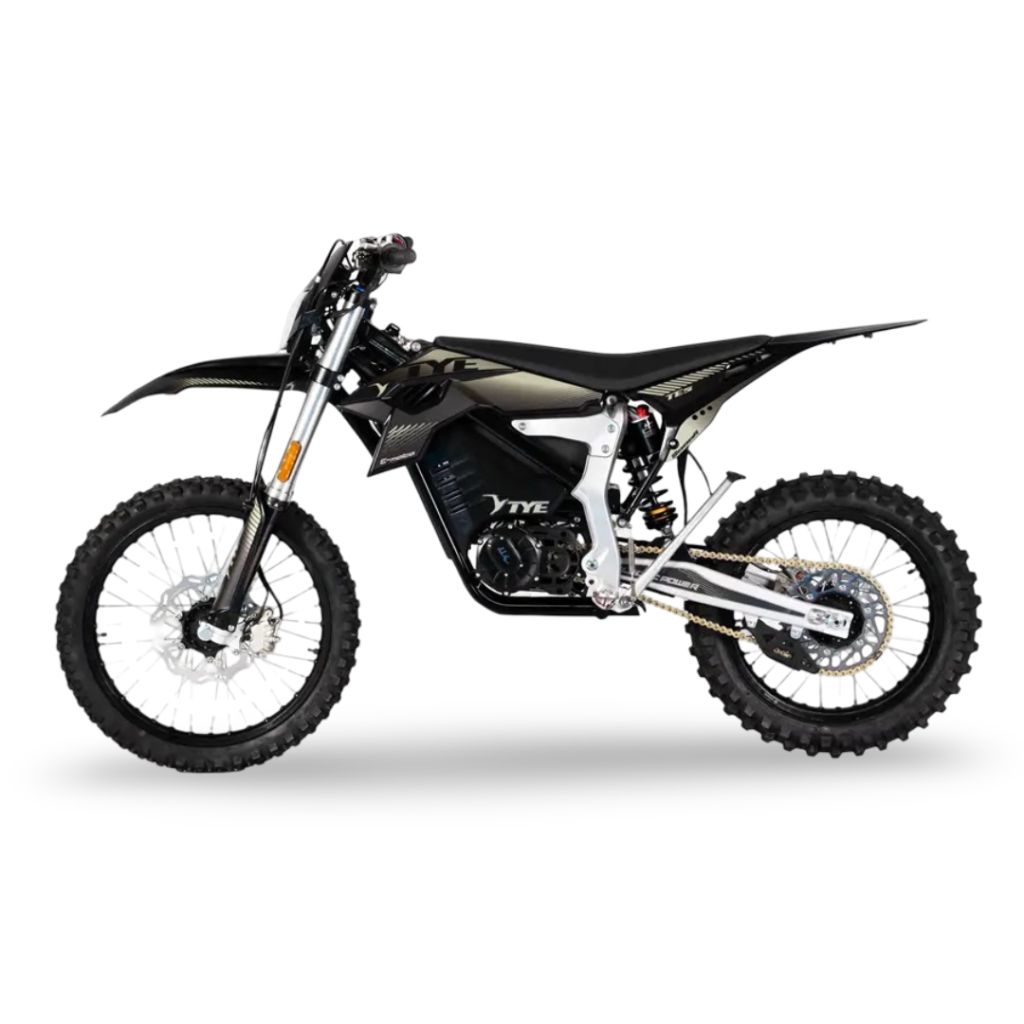

For more than a century, the sound of off-road motorcycling has been defined by noise—the sharp crackle of a two-stroke, the low rumble of a four-stroke, the mechanical clatter of a chain under load. That sonic signature is now being challenged, not by a louder engine, but by its absence. The TYEMOTO TYE5000 Electric Dirt Bike arrives as part of a broader shift in how riders experience power, control, and access to terrain. It is a machine designed not simply to replace a gasoline engine with a battery and a motor, but to use the distinct characteristics of electric propulsion to redefine what an off-road motorcycle can feel like—and where it can go.
To understand why the TYE5000 matters, it helps to first strip away the marketing language and look at the engineering fundamentals that separate an electric dirt bike from every other two-wheeled machine.
What “Electric Dirt Bike” Actually Means
An electric dirt bike is a purpose-built off-road motorcycle propelled by a high-output electric motor and a lithium battery pack, rather than a gasoline engine. It is not an electric bicycle with pedals and a throttle, nor is it a road motorcycle with knobby tires bolted on. The distinction matters because the design priorities are fundamentally different. A road-oriented electric motorcycle optimizes for range, highway comfort, and steady-speed efficiency. An electric dirt bike prioritizes suspension travel, ground clearance, low-speed torque, and the ability to absorb repeated impacts from rocks, roots, and jumps.
The TYE5000 reflects this philosophy from the ground up. It is built around a mid-mounted brushless DC motor, a high-density lithium battery, and a lightweight aluminum chassis—a clean-sheet off-road platform rather than a converted road machine. That architecture is the foundation upon which every riding characteristic depends.
The Heart of the Machine: A 20 kW Mid-Drive Motor
At the center of the TYE5000 sits a 20 kW brushless direct current motor, equivalent to approximately 26.8 horsepower. On paper, that places it in the performance territory of a 250cc four-stroke enduro machine. But raw horsepower comparisons between electric and combustion engines can be misleading, because the two systems deliver power in fundamentally different ways. A gasoline engine must build revolutions to reach its power band; an electric motor produces maximum torque from zero RPM.
For off-road riding, this difference is not a footnote—it is transformative. The TYE5000 produces up to 1,200 N·m of torque at the wheel, a figure that would be extraordinary in any vehicle but is almost incomprehensible in a machine weighing just 108 kg with the battery installed. That torque translates directly into the ability to climb steep gradients, crawl over rock ledges, and accelerate out of tight corners without clutch modulation or rev-matching. The bike reaches 100 meters from a standstill in 4.8 seconds and tops out at 125 km/h, yet the same powertrain also allows a rider to feather the throttle and creep at walking pace over technical terrain—a combination of violence and finesse that a clutch-and-gearbox drivetrain struggles to replicate with the same smoothness.
The decision to mount the motor centrally within the chassis, rather than in the rear wheel hub, is equally consequential. A mid-drive configuration centralizes mass and preserves the nimble handling that off-road riders depend on. Hub motors place significant unsprung weight inside the wheel itself, which degrades suspension response and reduces traction over rough ground. TYEMOTO’s choice of a mid-mounted brushless motor—independently developed by the company’s own R&D team—reflects an understanding that off-road performance is as much about chassis balance as it is about raw output.
Energy Storage and Control: The Systems Behind the Ride
The TYE5000 carries a 72V lithium battery pack using CATL cells, available in configurations ranging from 50Ah to 70Ah. This delivers up to 150 km of real-world range, depending on terrain and riding style, and a full charge from a portable generator or truck inverter takes approximately three to four hours. The pack is rated IP65 for water and dust resistance, making it suitable for the mud, water crossings, and dust that define off-road environments. Perhaps more importantly for multi-day adventures, the battery is designed for quick removal—it can be slipped out in under a minute and carried to a basecamp or charging point, transforming the logistics of riding far from the grid.
Managing the flow of energy from that battery to the motor is the controller, which in an electric dirt bike functions as the equivalent of a carburetor, ignition map, and exhaust tuner combined into a single digital interface. The TYE5000’s intelligent variable-frequency controller acts like cruise control on rough ground, maintaining a constant low speed without the on-off jerkiness that kicks up stones and disrupts traction. More significantly, riders can connect a smartphone or laptop to the bike’s Controller Area Network bus and reshape the power and torque map digitally—a mellow, linear delivery for slippery technical single-track, or an aggressive, instantaneous response for open fire roads. A Bluetooth-enabled Battery Management System allows real-time monitoring of charge level, cell temperatures, and remaining range, eliminating the guesswork that can be dangerous when far from a trailhead.
Chassis, Suspension, and the Terrain Feedback Loop
An electric motor’s torque is only useful if the chassis can put it to the ground. The TYE5000 uses an aluminum frame with a low-mounted battery, a layout that contributes to a planted feel and a low center of gravity. Suspension is fully adjustable front and rear, with hydraulic disc brakes and large rotors handling stopping duties. Ground clearance is listed at 318 mm, enough to keep the machine from hanging up on ruts and embedded rocks. Tire sizes—80/100-21 front and 110/90-18 rear—are conventional off-road dimensions, which means riders can choose from the established ecosystem of enduro and motocross rubber rather than being locked into a proprietary fitment.
The absence of a gasoline engine also changes the feedback loop between rider and terrain. Without exhaust noise and engine vibration, the rider’s attention shifts toward tire grip, suspension movement, and the subtle sounds of the trail itself. In deep mud, where a gas bike demands high revs, clutch feathering, and a certain amount of luck, an electric motor simply delivers torque instantly and lets the tire find grip. There is no lag, no waiting for the engine to climb into its power band, and no risk of stalling. Experienced gas-bike riders often describe this as revelatory—not because the electric bike is necessarily faster everywhere, but because it removes layers of mechanical mediation between the throttle and the ground.
Electric Versus Gasoline: The Honest Trade-Offs
The TYE5000 exists within a broader conversation about how electric dirt bikes compare to their combustion-powered counterparts, and that conversation is more nuanced than either enthusiastic marketing or nostalgic resistance suggests.
Where electric propulsion wins decisively is in torque delivery and low-speed control. Electric motors deliver 100% of their torque at zero RPM; there is no rev-building, no clutch engagement, and no powerband to find. For technical trail riding, this translates into a level of control that even experienced riders find unfamiliar at first—the ability to apply exactly the power needed, exactly when it is needed, without modulating a clutch or slipping a gear.
Maintenance is the other arena where electric dirt bikes change the ownership equation. There are no oil changes, no air filters to clean, no carburetor jets to unclog, and no valves to adjust. Post-ride maintenance on a TYE5000 consists of a wash-down and chain lubrication. A full charge costs between one and three dollars in household electricity, compared to ten to twenty dollars per ride in gasoline for a comparable gas bike. Over a riding season, those savings accumulate quickly, and the time saved on wrenching is often valued even more highly than the money.
Where gasoline still holds an advantage is in top-speed potential and refueling logistics. A gas 450cc motocross bike can exceed 70 mph, and most electric dirt bikes in the $3,000–$5,000 range top out between 45 and 62 mph. The TYE5000’s 125 km/h (approximately 78 mph) top speed puts it above that entry-level band, but the broader point stands: for long-distance desert racing or extended backcountry traverses where charging infrastructure is absent, a gas bike remains the more practical tool. The TYE5000’s answer to this limitation is not to pretend it does not exist, but to lean into the riding contexts where electric powertrains are not merely adequate but superior—shorter, high-intensity trail sessions, technical enduro loops, and private-land riding where noise and emissions are practical constraints rather than abstract concerns.
Silence as a Functional Capability
The absence of engine noise is often framed as an environmental benefit, and it is. But for off-road riders, silence is also a practical capability with consequences that are easy to overlook until experienced directly. A gas bike announces its arrival long before the rider reaches a vantage point or approaches wildlife. The TYE5000 can ride within 30 meters of deer without spooking them. For hunters, wildlife photographers, and anyone who values the solitude of the backcountry, this is not a novelty—it is a different way of moving through the landscape. The bike also features an ultra-low “stealth mode” for its LED lighting, allowing night riding without the disruptive glare of conventional headlights.
Silence also affects access. Because electric drivetrains produce zero tailpipe emissions and minimal noise, the TYE5000 is welcomed on many restricted trails and in state parks where gas bikes are banned. Less weight and no petroleum products mean minimal soil compaction and no risk of fuel spills in sensitive watersheds. As trail access continues to shrink for combustion-powered vehicles in many regions, the ability to operate in these environments is not just a convenience—it is a matter of preserving the freedom to ride.
The Market Context: Why This Moment Matters
The TYE5000 does not arrive in a vacuum. The global electric off-road two-wheeler market was valued at approximately US$422 million in 2025 and is forecast to reach US$1,335 million by 2032, growing at a compound annual growth rate of 18.1%. The broader dirt bike market is also expanding, from an estimated $8.66 billion in 2025 to $9.17 billion in 2026, with electric off-road innovation identified as a key driver of forecast-period growth.
What makes the electric off-road segment particularly interesting is that it is thriving while electric road motorcycles struggle to gain traction. The reason is structural rather than technological. Off-road riding typically involves shorter, high-intensity sessions on trails and tracks rather than long-distance travel. In that context, the traditional limitations of electric powertrains—range and charging infrastructure—are far less problematic, while their advantages—instant torque, silent operation, low maintenance, and lightweight handling—become decisive. Light electric off-road motorbikes have become one of the healthiest segments in the entire electric motorcycle market, and the TYE5000 positions itself within that segment as a high-performance option that bridges the gap between lightweight trail bikes and full-size motocross machines.
TYEMOTO itself traces its origins to 2018, when it began as a developer and manufacturer of motors for two-wheeled electric vehicles. The company’s background in motor research and development—rather than in motorcycle assembly—helps explain why the TYE5000’s powertrain is described as independently developed and patent-protected. The TYE3000 and TYE5000 were released as mass-production models in 2020, and the company has since expanded into markets including the United States, Canada, Australia, France, Germany, and several other European countries. The TYE5000 has passed EU CE and E-MARK certification, meaning it can be listed for road use in European markets—a crucial consideration for riders who want a single machine for both trail and road.
The Pioneer Spirit, Reconsidered
The phrase “release your inner pioneer” can read as marketing abstraction. But the history of off-road motorcycling is, at its core, a history of access—of riders seeking out terrain that resists easy passage and finding freedom in places most people never see. The barriers to that freedom have changed over time. Noise complaints, emissions regulations, trail closures, and the sheer maintenance burden of combustion engines have all, in different ways, constrained where and how riders can explore.
The TYE5000 does not claim to eliminate every one of those barriers. It will not outrun a gas bike across a vast desert, and it will not satisfy a rider who finds meaning in the mechanical ritual of clutch, gear, and exhaust note. But for a growing number of riders, the trade-offs have shifted. The instant torque, the silent passage through sensitive landscapes, the ten-minute post-ride wash-down instead of an afternoon of oil changes and filter cleaning—these are not compromises. They are a different set of priorities, expressed through a different set of engineering decisions.
The pioneer spirit has never been about a particular fuel source. It has been about the willingness to go beyond the mapped trails and the familiar routines. The TYE5000 is a machine built for that instinct, using the distinct capabilities of electric propulsion to remove barriers that have increasingly constrained it. Whether it represents the future of off-road motorcycling or one branch of a diversified future, it makes a compelling case that the silent revolution on the trail is no longer experimental. It is already here, and it is asking riders to reconsider what they value in the machines they take into the wild.


