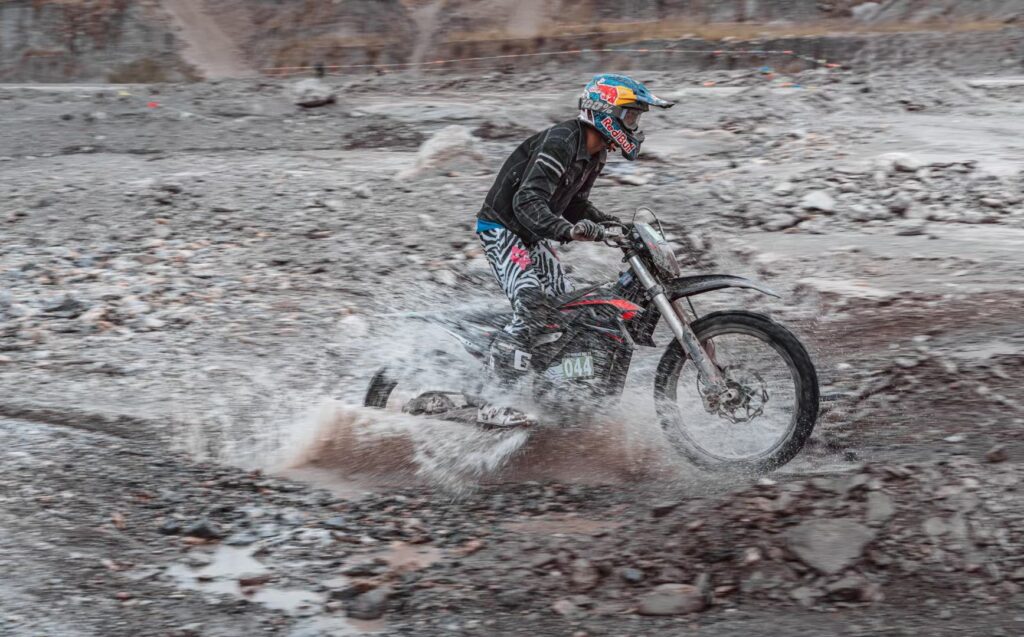

There’s a moment every electric off-road rider remembers. You’re standing at the edge of a trail, the morning air is cool, and you twist the throttle for the first time. What you expect is noise. What you get is silence — and then motion. Instant, smooth, powerful motion.
That’s the magic of an adult electric off road motorcycle. No engine roar. No exhaust fumes. No clutch to feather or gears to hunt. Just you, the bike, and the trail. It’s a completely different way to experience off-road riding, and for thousands of adults every year, it’s become the only way.
The electric off-road motorcycle market is booming. The global electric off-road motorcycle market was valued at approximately $1.91 billion in 2025, with roughly 292,000 units produced worldwide. Europe leads with about 45% of global share, followed by North America at 33%. Machines like the TYEMOTOR TYE5000, with its 72V, 25 kW mid-drive motor and 1,200 N·m of wheel torque, represent a new generation of electric off-road motorcycles built for hunters, explorers, and adventure riders who want to go anywhere, anytime, without announcing their presence.
But riding an electric off road motorcycle well takes a different skill set than riding a gas bike. The torque is instant. The bike is quieter than you expect. The power delivery is linear and relentless. If you approach it like a gas bike, you’ll struggle. Approach it with an open mind, and you’ll discover a whole new level of confidence on the trail.
This guide covers the essential tips for off-roading on an adult electric off road motorcycle. Whether you’re a complete beginner or a seasoned gas rider making the switch, these tips will help you ride smoother, safer, and with a bigger grin on your face.
Before You Ride: Fit, Gear, and Pre-Ride Checks
Get the Right Fit First
A bike that fits properly is easier to balance, steer, and stop. Before you even think about performance, check the basics.
Can you reach the controls without stretching? Can you put both feet on the ground when stopped? The TYE5000’s aluminum frame and low-mounted battery contribute to a planted, confidence-inspiring ride, but every rider is different. The handlebar should not force your shoulders into an awkward position, and the brake levers should be easy to cover with one or two fingers.
Overall weight matters as much as seat height. Ask yourself whether you could lift the bike after a low-speed fall or move it through a tight space without power. The TYE5000 weighs 108 kg with the battery installed — roughly half the weight of a comparable 250cc four-stroke. That lightness makes a real difference on technical terrain, especially when you need to pick the bike up after a tip-over.
Wear the Right Gear
A helmet is the starting point, not the entire plan. Eye protection, gloves, sturdy over-the-ankle footwear, long sleeves, long pants, and knee and elbow protection can reduce the consequences of a fall. For serious off-road riding, motocross boots and gloves, riding pants with knee and hip padding, jerseys with elbow padding, and chest and shoulder protectors are recommended.
The good news? Electric off-road motorcycles are quieter and smoother than gas bikes, which means less fatigue and more comfort on long rides. But that doesn’t mean you can skip the gear. Dress like you’re going to ride, not like you’re going to the beach.
Do a Pre-Ride Inspection
Before every ride, take five minutes to check the machine. This isn’t optional — it’s the difference between a great day and a broken-down bike miles from the trailhead.
Check tire pressure. Off-road tires need the right pressure for the terrain. Too hard and you’ll bounce off rocks; too soft and you risk pinch flats. Inspect the chain — clean and lubricated, with proper tension. A chain that’s too tight puts stress on the motor bearings; one that’s too loose can damage the swingarm.
Check the brakes. Squeeze the levers — they should feel firm, not spongy. The TYE5000 uses a multi-piston hydraulic brake system with large rotors, so stopping power should be immediate and predictable.
Check the battery level. A first ride should stay close to the starting point and use a route with an easy exit. Begin with a fully charged battery, and plan to turn back with a generous reserve.
And check your connectors. Periodically disassemble the main electrical connectors and clean them with contact spray to prevent corrosion. This is especially important if you ride in wet conditions.
Mastering the Throttle: The Most Important Skill
Respect the Instant Torque
Electric motors deliver full torque from zero RPM. Twist the throttle and the bike goes — now. There’s no revving up, no clutch engagement, no powerband to find. That instant response is a game-changer for control and confidence. It’s also the thing that catches new riders off guard.
Learn the throttle before the trail. Practice in the lowest available mode on a flat, open surface. Keep your wrist neutral, apply power progressively, and close the throttle before becoming tense or losing your line. Do not grip the handlebar as if you are hanging from it — a rigid upper body makes steering less precise and can cause accidental throttle movement over bumps.
The TYE5000’s ride-mode selector is your friend here. Start in Eco mode. Get comfortable with the throttle response at low speed. As your skills develop, unlock more power. One bike grows with you for years — no need to “graduate” to a bigger machine.
Use Smooth, Progressive Inputs
Sudden, hard twists of the throttle can lead to wheel spin or even loss of control, especially on loose surfaces. Roll on the throttle gradually as you exit a corner rather than abruptly accelerating. This keeps your rear wheel planted and helps prevent oversteering.
In tight, technical sections, small, controlled throttle adjustments are key. Modulating the throttle — small, deliberate adjustments instead of a constant or jerky twist — helps you maintain balance, especially on uneven or rocky trails where sudden bursts of power can cause instability.
On loose or slippery surfaces, be extra gentle to avoid wheel spin. On hard-packed dirt or asphalt, you can afford more aggressive throttle use. The better you adapt to the surface, the more efficiently you’ll navigate mixed terrain.
Understand Regenerative Braking
Some electric bikes offer regenerative braking that engages when you ease off the throttle. The TYE5000 uses regenerative braking to recapture energy during deceleration while topping up the battery.
Here’s what you need to know: a closed throttle is not a neutral input. Some bikes settle when you shut off. Others slow hard from motor drag or regenerative braking. Test it on flat open ground first. Learn whether closing the throttle steadies the bike or unsettles the rear on loose soil. That answer changes your entry plan for every corner and descent.
Regenerative braking is excellent for range and efficiency, but some riders prefer lower or no regen for technical off-road riding. Adjust it to your preferences. The key is to know how it behaves before you need it.
Body Position: The Secret to Control
Stand Up
Sitting may feel natural, but standing on the foot pegs gives your arms and legs more ability to absorb terrain. Start with level ground. Keep your knees and elbows relaxed, your head up, and your weight centered. The goal is not to stand tall — it is to create room for the bike to move without throwing your body off balance.
When approaching rocks, roots, or shallow ruts, look beyond the obstacle instead of staring directly at it. The bike tends to follow your vision. A calm, forward gaze also gives you more time to adjust speed and choose a line. Keep your eyes up — the bike goes where your eyes go.
Adjust Your Body to the Terrain
Adjust your body position in response to throttle inputs. Lean forward when accelerating to keep the front wheel down. Shift back to maintain balance when braking or descending.
For small hills, shift your body weight forward by sliding forward on the seat. For steep hills, stand on the footrests and lean well over the front wheel to shift as much weight as possible forward. On descents, shift your weight back and let the front wheel float over obstacles.
The TYE5000’s wide deck and low center of gravity make this easier. You’re not perched on top of the machine — you’re standing into it. That planted feel builds confidence, and confidence builds skill.
Braking: Stop Like You Mean It
Use Both Brakes Deliberately
New riders often rely too heavily on one brake. The front brake provides substantial stopping force, while the rear brake helps settle the bike and manage speed on loose terrain. Learn how each brake feels before riding downhill. Practice controlled stops from low speed. Apply both brakes smoothly while keeping the bike upright.
Avoid grabbing the front brake suddenly on gravel or turning sharply while braking hard. As confidence improves, repeat the drill at moderate speeds and on slightly different surfaces.
The TYE5000’s hydraulic disc brakes with large rotors provide strong, linear stopping power. Combined with regenerative braking, you get confident stopping power and improved efficiency. But remember — brakes are only as good as the rider using them. Practice makes perfect.
Brake Before the Corner, Not In It
This one habit fixes more switchbacks than any body-position tip. Slow down before the corner, not inside it.
Tight turns want balance, timing, traction, and throttle discipline in the same two seconds. An adult electric off road motorcycle adds a wrinkle. No clutch to slip. Torque lands the moment your wrist moves. On an electric dirt bike, the ride-mode selector is the closest thing you get to a slip zone.
The sequence for every corner is: read the terrain (grade, surface, apex, exit, bailout point), slow down (finish hard braking while upright), steer (outside entry, later apex, eyes through the exit), and drive (small steady throttle as the bars unwind). Out of order, the corner runs you. In order, you own it.
Climbing and Descending: Conquer Elevation
Climbing with Confidence
Steep inclines are where electric torque shines. The TYE5000’s instant torque means it climbs without hesitation — no revving, no slipping, just steady, controlled ascent. The bike has enough torque to climb 25% gradients without drama.
When tackling steep inclines, lean forward, keep a firm grip on the bars, and use smooth throttle control to avoid wheelspin. For very steep climbs, stand on the footrests and lean well over the front wheel. Keep your momentum steady — don’t chop the throttle mid-climb. The instant torque of an electric motor makes this easier than on a gas bike, because there’s no powerband to fall out of.
Descending with Control
Descending is where regenerative braking earns its keep. On a gas bike, you’d be feathering the clutch and riding the brakes. On an electric bike, easing off the throttle engages regen, which slows the bike while topping up the battery.
Shift your weight back and let the front wheel float over obstacles. Keep a light grip on the bars and let the suspension work. The TYE5000’s long-travel MNT hydraulic suspension is designed to swallow ruts and rock ledges, so trust it.
Use both brakes progressively. Don’t grab a handful of front brake on loose descents — that’s how you end up doing an unplanned endo. Smooth, progressive inputs keep you in control.
Battery Management: Ride Longer, Ride Smarter
Understand Real-World Range
Manufacturers love to quote big range numbers. Real-world range depends on rider weight, terrain, temperature, and how aggressively you use the throttle. A claimed 50-mile range in perfect conditions might be 35 miles in the real world.
Published range is a reference, not a promise. Soft ground, steep climbs, cold weather, rider weight, tire pressure, and repeated hard acceleration can all increase energy use. The TYE5000’s 72V CATL pack delivers up to 150 km of real-world range, recharges in three to four hours, and can be swapped in under 60 seconds.
Ride Efficiently
Keep acceleration smooth and avoid full-throttle starts. Hard acceleration is one of the easiest ways to drain an electric dirt bike battery quickly. Start smoothly, increase throttle gradually, and avoid unnecessary bursts of acceleration.
Ride at a moderate speed instead of staying at top speed. As speed increases, wind resistance rises and the motor needs more sustained power to maintain that speed. Use high speed when you want performance. Use moderate, steady cruising when you want better range.
Use the right riding mode for the right terrain. Eco or lower-power modes are useful for pavement, city streets, light trails, and situations where you do not need maximum torque. Higher-power modes are better for climbing, loose surfaces, and difficult off-road sections.
Maintain proper tire pressure. When tire pressure is too low, the contact patch becomes larger and rolling resistance increases. The motor then needs more energy to move the bike forward. Check tire pressure regularly, especially before long rides.
Battery Care for the Long Haul
For daily riding, use the 20-80% rule: charge to 80% and ride until 20%. Never discharge your battery to 0%. If you return from a ride with a very low battery, charge it as soon as possible.
Don’t charge the battery immediately after intensive riding when it is still hot. Wait 30 to 60 minutes for it to cool down. Also, do not charge it in rooms where the temperature is below freezing. Charging a frozen battery can cause permanent cell damage.
If you’re not riding for more than a week, store the battery at 40% to 60% charge. Check the condition every month and top it up a little if necessary. Never leave it fully charged or completely discharged for a long time.
Maintenance: Keep It Simple, Keep It Running
The Electric Advantage
This is where electric off-road motorcycles shine. Gas-powered bikes require oil changes, air filter cleanings, spark plug replacements, valve adjustments, and exhaust system care. Electric bikes have none of that.
Your maintenance list shortens dramatically: brake pads, tires, chain lubrication, and keeping the machine clean. The TYE5000, with its sealed bearings and minimal moving parts, requires a ten-minute wash-down and chain lube after each ride.
That simplicity translates to savings. Annual service on a combustion bike averages about $600 in parts and labor, versus $200 for an electric. If you pay a dealer for service, electric saves you $1,000 to $3,000 over five years.
Cleaning Without the Pressure
Although electric dirt bikes are resistant to water spray, they are not impervious to high pressure. Avoid high-pressure washers — they can push water into bearings, connectors, and the controller.
Use a bucket of water, mild soap, and a soft brush. After washing, dry the bike thoroughly with a cloth or compressed air, being careful around the electronics. Then lubricate your chain and any pivot points to prevent corrosion.
Chain Care
Clean and lubricate the chain after every mud ride. Check the tension regularly. A chain that’s too tight puts stress on the motor bearings, while one that’s too loose can damage the swingarm. A well-maintained chain is a quiet chain, and a quiet chain means more of that beautiful silence you bought an electric bike for.
Trail Etiquette and Legal Awareness
Be Seen, Be Heard (Sort Of)
The quietness of electric drive is the first reason many people fall in love with it. Less noise and more of the sound of the wind and tires rolling over gravel makes for a more relaxed experience.
But quiet is also a challenge. The risk with electric off-road bikes lies not in the quietness itself, but in instantaneous torque, silent approach, and a mismatch between speed, rider, and terrain. Neighbors may not complain, but passers-by might not hear you. When riding in open areas, make “being seen” your first lesson.
Know Where You Can Ride
Electric machines are often welcomed on trails where gas bikes are banned. Zero tailpipe emissions mean the TYE5000 is welcomed on many restricted trails and in state parks where gas bikes are banned. Quieter operation opens doors that noise ordinances close.
But that doesn’t mean you can ride anywhere. In the US, riding in national forests is only permitted on designated routes marked on the Motor Vehicle Use Map (MVUM). Unmarked areas are off-limits. The approximately 250 million acres of public land managed by the Bureau of Land Management offer extensive off-road riding opportunities, but you must stick to designated routes, and permits are required in some areas.
Check local regulations before you ride. A little research prevents a lot of trouble.
Leave No Trace
Off-road riding is a privilege, not a right. Ride on designated trails. Don’t tear up sensitive areas. Pack out what you pack in. Respect other trail users — hikers, mountain bikers, equestrians. The future of trail access depends on riders who treat the land with respect.
The Bottom Line: Ride Smart, Ride Electric, Ride Happy
Off-roading on an adult electric off road motorcycle is one of the most joyful experiences in motorsports. The instant torque, the silent operation, the low maintenance, the access advantages — they all add up to a riding experience that’s simply more fun, more often.
The TYE5000 represents the cutting edge of what these machines can do. A 72V, 25 kW mid-drive motor. 1,200 N·m of wheel torque. A 108 kg frame that’s half the weight of a comparable gas bike. Quick-swap battery technology that eliminates range anxiety. LED lighting with ultra-low stealth mode for night riding. This is a machine built for hunters, explorers, and adventure riders who want to go anywhere, anytime, without announcing their presence.
But the bike is only half the equation. The other half is you — your skills, your preparation, your respect for the terrain and the machine. Master the throttle. Stand up. Use both brakes. Manage your battery. Keep it clean. Ride within your limits, and push them gently as your confidence grows.
The trails are waiting. The quiet revolution is real. And your next adventure starts with the right machine and the right mindset.
Go find your trail. Ride it like you mean it. And enjoy every silent, torque-filled second of it.


